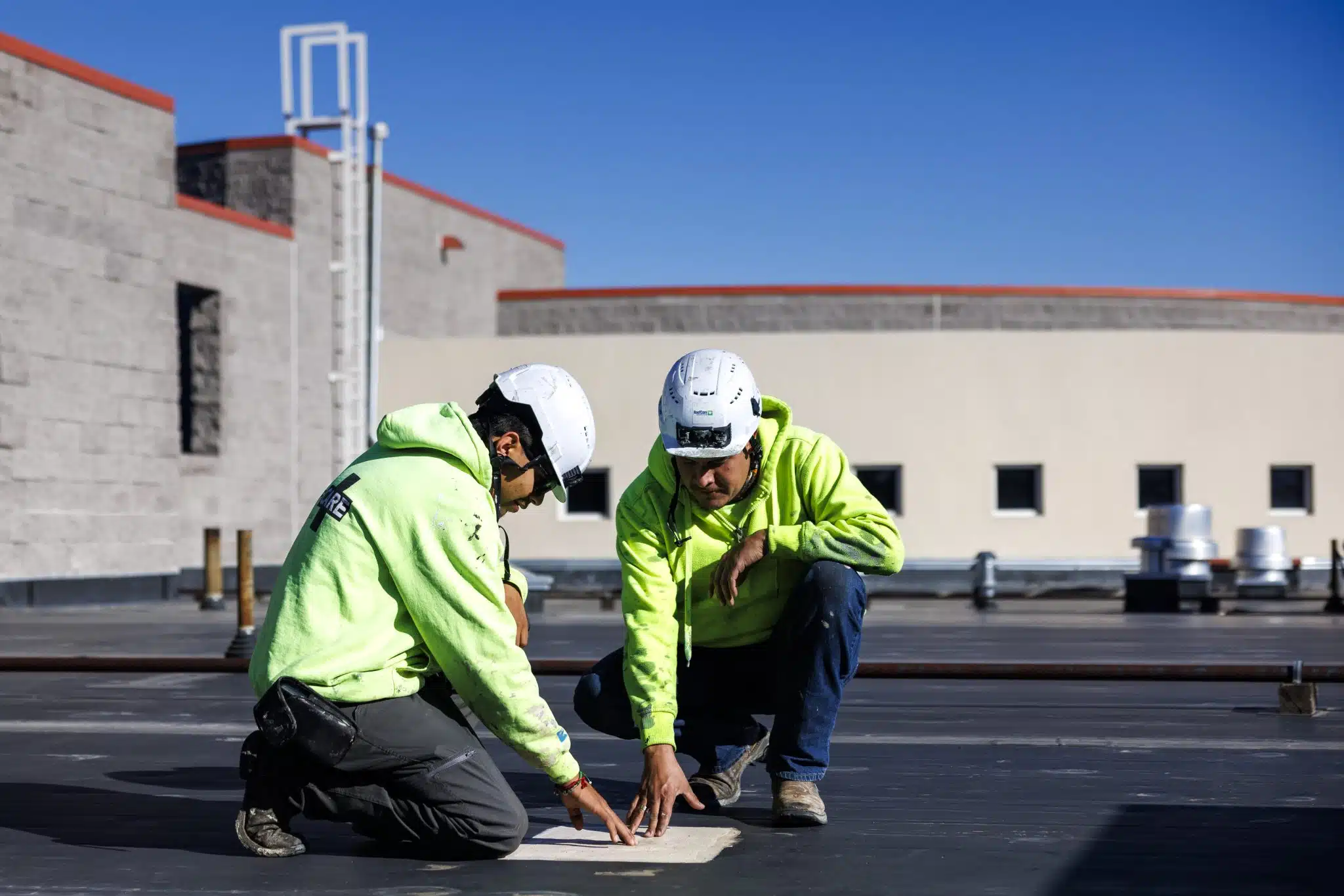
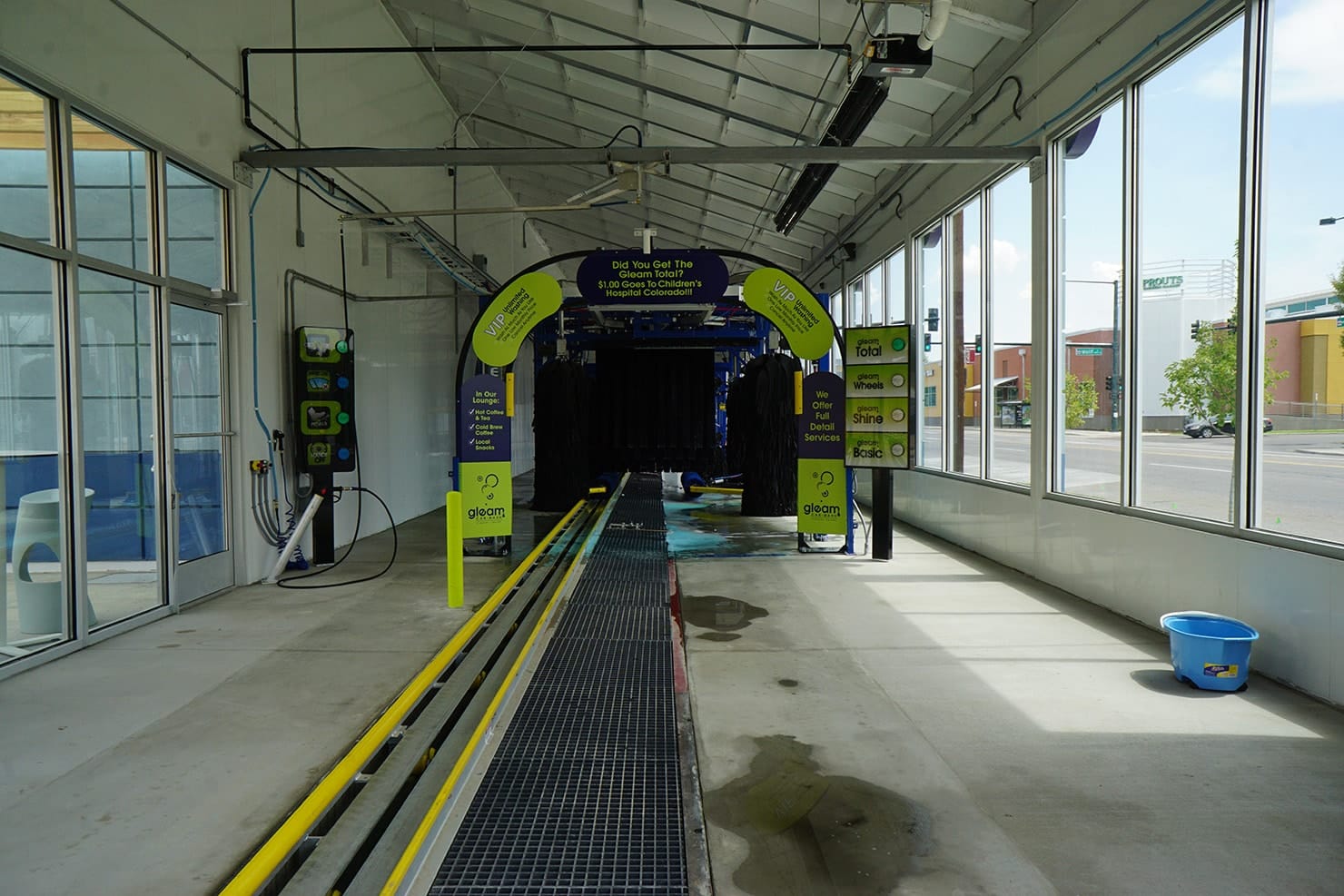
The roof on a car wash gets attacked from the inside
Most commercial buildings wear out their roofs from the top down. A car wash wears its roof out from the bottom up. Inside an express tunnel or an in-bay automatic, the air sits at near-saturation humidity through the entire operating day, and that warm wet air carries detergents, brightener acids, drying agents, and wax solvents straight up to the underside of the deck. That vapor condenses on cold steel, runs down the flutes, and corrodes the deck and the fasteners that hold the roof system to it - usually long before anything on the top surface looks worn. We roof car washes in Raleigh with that hidden attack as the starting assumption, not an afterthought.
We have walked tunnels along Capital Boulevard, the Glenwood Avenue retail run, and the fast-growing fringe of car washes off US-401 and NC-55 in Apex and Holly Springs where a national express chain has put up new sites in the last few years. The pattern repeats: the top membrane reads fine on a drone pass, but pull a fastener at the wash arch end of the tunnel and the threads come out powdered with rust. That is the part of the job a generalist roofer misses.
Why a car wash is not just a small flat roof
Raleigh's car wash inventory has grown alongside the population. New rooftops keep appearing on the commercial pads off Triangle Town Boulevard, along the Six Forks Road corridor, and at the busy intersections feeding I-540 in North Raleigh, where commuter traffic supports the volume an express model needs. Each of those sites packs an unusual amount of roofing complexity into a small footprint, and the failure points are specific to the building type.
Vapor and chemistry come up through the deck
The single biggest difference between a car wash roof and any other low-slope roof is the direction of the moisture drive. We treat the underside of the deck as a wet environment. That means a vapor retarder is part of the conversation, the deck itself gets inspected for existing corrosion before we commit to a recover, and fastener selection leans toward stainless or heavily coated assemblies rather than the standard plated screws that disappear in this atmosphere. If the existing deck is already pitting, a recover over the top solves nothing - we say so before we quote it.
The wash arch and dryer end take the worst of it
Heat, steam, and chemical mist concentrate at the wash arch and again at the high-horsepower dryer station. The thermal cycling there is brutal: hot wet air during a cycle, then a cooler dry-down between cars, repeated hundreds of times a day. Seams and flashings fatigue faster in that zone than anywhere else on the building, so we detail it differently - wider laps, reinforced corners, and a membrane chosen for chemical tolerance rather than whatever was cheapest at bid.
Membrane has to tolerate detergents, not just sun
Many single-ply membranes are warranted against weather but carry explicit exclusions for chemical exposure. The alkaline detergents and waxes in a modern wash menu can attack the wrong membrane from the underside vapor and from any topside drips off exhaust hoods. We lean toward PVC in the tunnel zone because its chemistry holds up to those compounds better than standard TPO or EPDM, and we confirm the specific wash chemicals in use against the manufacturer's resistance data before we specify anything.
Vacuum canopies and pay-station covers are their own scope
The free-vacuum canopies that define the express model, plus the pay-station and entry canopies, are separate roofing problems. They take vehicle exhaust, tire-shine overspray, and full outdoor thermal swings, and the connection where a canopy ties back to the main building is the most common chronic leak we find on Raleigh express sites. We inspect and price those transitions as discrete items, not a rounding error on the main roof.
Working around a wash that never closes
Car washes in this market run seven days a week, and the good ones do their heaviest volume on warm weekend afternoons and the first clear day after a stretch of rain - exactly when Raleigh's pollen and road grime have everyone lining up. We plan the work around that reality. Tunnel-roof work happens in the early-morning window before the first wash cycle or after close; canopy and equipment-room work can run during business hours with the lanes managed so cars never pass under an active work zone. We dry the building in every night. An open hole over running wash equipment is not something we leave to chance overnight.
What we look at on a car wash roof inspection
A useful inspection on this building type goes past the membrane surface. We check the things that actually fail on car washes:
- Deck and fastener condition at the wash arch and dryer end, where underside corrosion starts
- Exhaust and ventilation penetrations over the tunnel, including curb height and flashing condition
- Seam and lap integrity in the high-humidity zones versus the cooler entry and exit ends
- Drainage and ponding over the equipment room and back-of-house, where slope is often an afterthought
- Vacuum canopy membrane or panel condition and the canopy-to-building flashing
- Edge metal and any signs of chemical staining or blistering near exhaust discharge
You get back a marked-up roof diagram, photos keyed to location, and a plain recommendation that separates what needs a repair, what needs a section replaced, and what is fine for now.
Common questions from Raleigh car wash owners
Why does my roof look fine but my deck is rusting?
Because the damage is coming from inside. The humid, chemical-laden tunnel air condenses on the underside of the steel deck and corrodes it and the fasteners from below. The top membrane can look almost new while the structure beneath it is losing strength. This is the defining failure mode of car wash roofs and the reason we inspect from the deck side, not just the surface.
What membrane do you put on a wash tunnel?
For the tunnel itself we usually specify a fully adhered PVC membrane because it resists the alkaline detergents and waxes better than standard TPO or EPDM. Fully adhered also avoids a dense fastener field driven into a deck that is sitting in a corrosive atmosphere. For the equipment room, lobby, and canopies, where chemical exposure is lower, a different system is often the right call. We match the system to the zone.
Can you reroof while we stay open?
Yes. We sequence the work around your wash hours - tunnel work in the closed window, exterior and canopy work during the day with the lanes controlled. The building is watertight at the end of every shift.
Do you handle the vacuum canopies too?
Yes. Vacuum canopies, entry and pay-station covers, and the flashings where they meet the main building are part of how we scope a car wash. Those transitions are a frequent leak source and we address them directly rather than ignoring them.
How does chemical exposure affect the warranty?
Many membrane warranties exclude chemical attack. Before we specify a system over a wash tunnel, we confirm with the manufacturer that the chemicals in your wash menu are compatible with the membrane and that the installation conditions are covered. Some manufacturers offer chemical-exposure endorsements, and we pursue those when they apply.
Get a car wash roof assessment in Raleigh
If you run a tunnel, in-bay, or self-serve site anywhere from North Raleigh down through Apex, Cary, and Garner, we will walk the roof, check the deck and fasteners from below, look hard at the wash arch and canopies, and give you a written scope you can actually budget against. Reach out through our contact page to set up a visit.