Apex has grown from a small depot town into one of Wake County's most active suburban commercial corridors - the US-1 and NC-55 intersection has become a genuine business park cluster, and the historic downtown on Salem Street is in its own commercial revival.
Apex sits at the southwest corner of Wake County where US-1 and NC-55 cross, and that geography has made it one of the Triangle's fastest-growing commercial markets. The US-1 corridor from Cary through Apex south toward Holly Springs now carries a continuous band of business park and light industrial development that did not exist a decade ago. The NC-'s completion through this corner of Wake County has pulled distribution, logistics, and professional services development into a corridor that was previously suburban commercial.
From our Raleigh office, we reach Apex via I-440 west to I-40 west to US-1 south - a drive that runs about 30 to 35 minutes under normal traffic. We run regular service routes through Apex and treat the US-1 business park corridor as a standard coverage zone for inspection and emergency response.
Apex commercial buildings span a wide age range that shapes what roofing work makes sense. The historic downtown on Salem Street has 1880s and 1890s brick commercial buildings that require period-appropriate parapet flashing detailing. The US-1 corridor business parks are predominantly post-2000 construction with first-generation TPO systems approaching the end of their warranty cycles. We assess both honestly and scope based on what the building's actual condition warrants.
US-1 Corridor and the West Wake Business Parks
The US-1 business park corridor through Apex - running from Cary's commercial boundary south through the Beaver Creek area and the NC-55 interchange - has absorbed a decade of Wake County's suburban commercial demand. Buildings here run from 20,000 square foot single-story professional office suites to 200,000 square foot light industrial and distribution facilities. The predominant roof system across this corridor is mechanically attached TPO, most of it installed between 2005 and 2015 and now entering the phase where seam performance needs documented assessment.
The Beaver Creek commercial district near the US-1 and NC-55 interchange is a regional retail cluster - anchored-center retail that draws from a broad southwest Wake County trade area. Large-footprint anchor and junior anchor buildings in this district are typical 1990s and 2000s EPDM or TPO construction. Many are now on second or third repair cycles without a comprehensive replace-or-recover decision backed by moisture survey data. We do those surveys before scoping, not after the demo crew is already on the roof.
The I-540 arc through the Apex area has opened new industrial and logistics parcels that are being developed with current-code construction. New construction in this corridor runs TPO 60-mil or 80-mil on polyiso insulation assemblies with 20-year NDL warranty paths. We are active on new construction scopes in this area alongside our maintenance and replacement work on the older US-1 corridor buildings.
Historic Downtown Apex and Salem Street
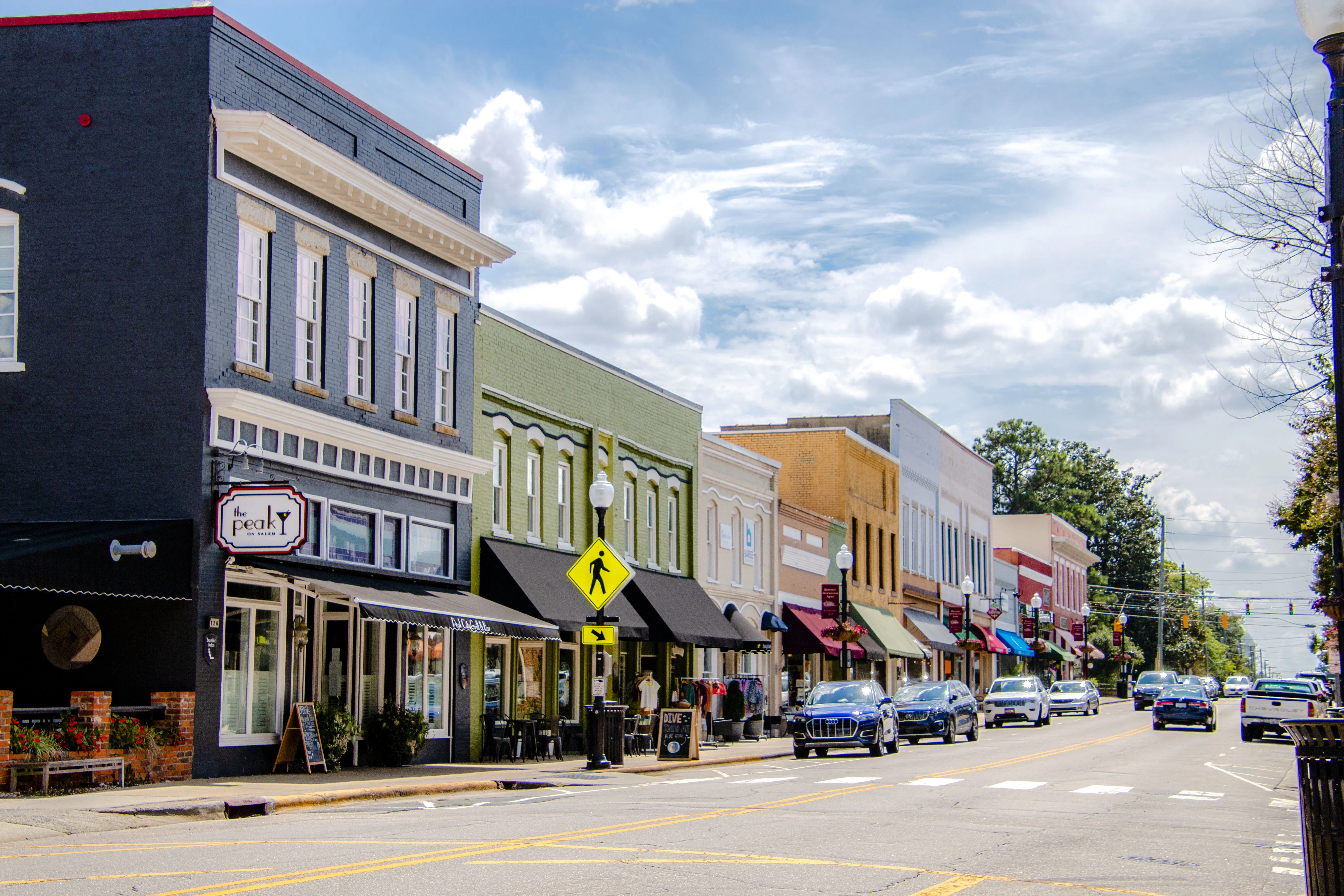
Downtown Apex on Salem Street is one of the Triangle's more intact small-town commercial districts. The brick storefronts dating to the late 1800s and early 1900s are the kind of buildings that generate real roof problems if contractors treat them like standard flat commercial buildings - original parapet caps, brick corbeling, and historic through-wall flashing all require specific detailing to integrate with modern membrane systems without introducing new failure paths.
The Town of Apex has invested in downtown preservation and permitting that reflects the historic character of the district. Commercial roofing permits in the downtown area go through the town's building inspections office, and projects on buildings within any historic overlay zone may require additional review. We navigate this during permitting and document the applicable requirements before scoping.
Adaptive reuse activity on the older Salem Street commercial buildings - converting retail and warehouse space to restaurant and event use - changes roofing considerations. Restaurant exhaust and ventilation penetrations on historic flat roofs need careful curb flashing design to avoid the kind of parapet infiltration that the original buildings were not designed for. We treat these as custom flashing scopes, not standard penetration details.
NC-55 and the Southern Apex Commercial Corridor
NC-55 running south from Apex toward Holly Springs is in an active commercial development phase. Business parks, medical office buildings, and professional services buildings are being constructed in what was farmland ten years ago. This part of the Apex commercial market is characterized by new construction - buildings that will need their first formal inspection program and maintenance contracts established now, before warranty periods expire and records become disconnected from the buildings they cover.
Medical office buildings along the NC-55 corridor serve a southwest Wake County population that is growing faster than most Triangle submarkets. These buildings typically have ground-floor clinical operations with rooftop HVAC infrastructure sized for medical occupancy - more mechanical penetrations per square foot and higher HVAC continuity requirements than standard office construction. We treat that as a pre-construction planning factor, not a day-of constraint.
For portfolio owners managing multiple Apex commercial buildings - we have clients managing business park products across the US-1 and NC-55 corridors - we develop a multi-building inspection schedule that tracks remaining warranty periods, membrane condition, and capital replacement timing across the portfolio. That consolidated view lets asset managers make replacement decisions based on condition data rather than on when the next leak shows up.
Frequently asked questions
Do you cover the US-1 business park corridor south of Apex toward Holly Springs?
Yes. We treat the US-1 corridor from the Cary-Apex line south through Holly Springs as a continuous service zone. Buildings in the Apex, Holly Springs, and Fuquay-Varina areas along US-1 are all within our regular route network from the Raleigh office.
Can you work on the historic brick buildings in downtown Apex?
The historic buildings on Salem Street require specific flashing details that account for the original brick construction - not just standard membrane termination. We assess these buildings in writing before scoping any work, document the existing parapet and flashing conditions, and specify the replacement detail against the actual building rather than a generic flat-roof template.
What permits are required for commercial roofing in Apex?
Commercial roofing work in Apex requires a building permit through the Town of Apex Inspections division. Projects that involve structural deck work or penetration modifications may trigger additional reviews. We handle permit applications and required inspections as part of pre-construction on every project and include permit closeout documentation in the project's final package.