Commercial roofing for self-storage facilities, mini-storage buildings, and climate-controlled storage properties throughout Raleigh, NC.
Uncle Bob's Self Storage - now operating as Life Storage - maintains well-established facilities throughout the Raleigh metro area, including locations near the Beltline and along Capital Boulevard that serve the region's rapidly growing commercial and commercial customer base. Commercial roofing for self-storage in Raleigh requires attention to a climate that combines hot, humid summers, occasional ice storms in winter, and the periodic threat of tropical systems tracking inland from the Carolina coast with enough residual wind and rain to cause significant damage to large, exposed roof surfaces.
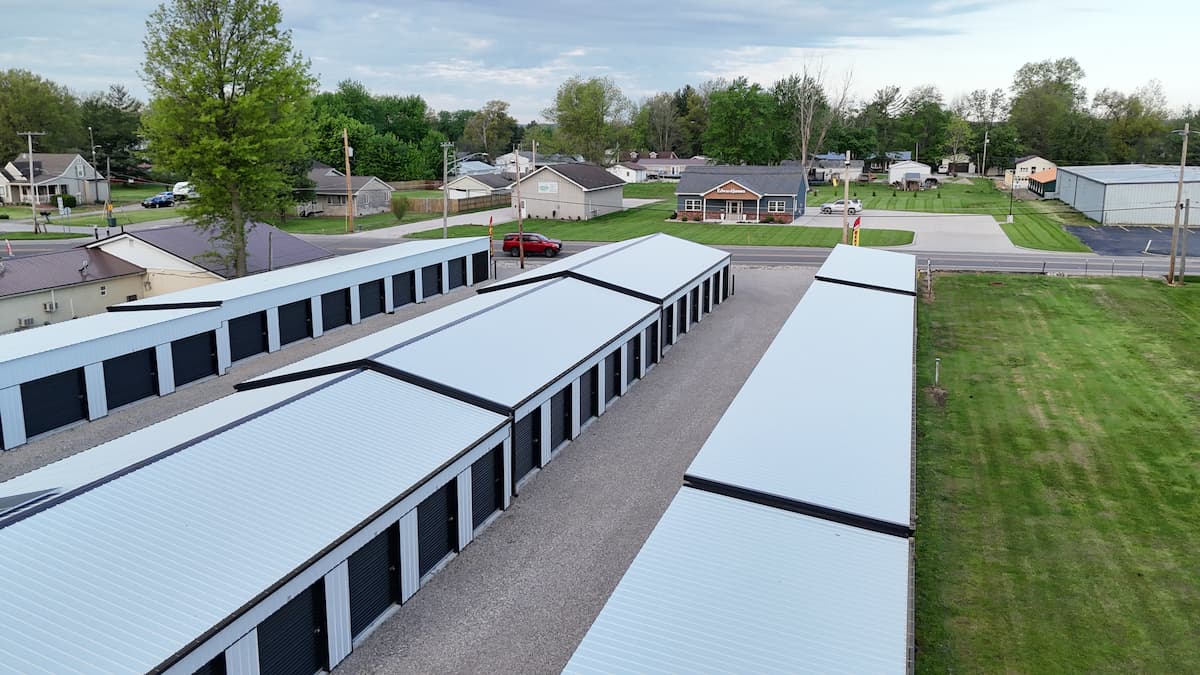
Raleigh's self-storage market has grown dramatically alongside the Research Triangle's population, and many newer facilities in the suburbs of Wake County feature large multi-story buildings with low-slope roofs covering sixty thousand square feet or more. At that scale, every square of roofing represents a compounded investment that rewards quality specification and installation. We design TPO and PVC membrane systems for Raleigh storage facilities with reflective surfaces that reduce cooling loads during the region's long, humid summers, insulation values that meet North Carolina's energy code, and drainage layouts engineered for the area's intense summer thunderstorm events.
Tropical weather is an underappreciated risk for Raleigh self-storage operators. While the city sits far enough inland to avoid the direct brunt of Atlantic hurricanes, weakening tropical systems regularly track through central North Carolina with wind gusts that can damage poorly secured edge metal and sustained rainfall events that expose any drainage weakness. We detail perimeter flashings and copings to withstand sustained winds consistent with Raleigh's wind design category, providing a margin of safety beyond what standard local code requires.
Ice storms are the winter wild card in the Raleigh climate. Unlike the heavy snow loads of northern cities, Raleigh's winter precipitation often arrives as freezing rain that coats surfaces with a dense, heavy layer of ice. This load can be substantial on a large, flat storage roof if it accumulates across the full surface. Our structural review process for re-roofing projects examines the existing deck for any signs of sagging or prior overload, and we advise operators on drainage improvements that help ice melt and drain rather than pool and refreeze.
Tenant protection is always the most direct commercial argument for roofing investment. The Research Triangle's storage customer base includes a high proportion of corporate clients - relocated executives, lab equipment being repositioned, data center operators using nearby storage for document archiving - who have little tolerance for moisture damage. A facility with a documented maintenance program and current roof warranties signals to these tenants that their goods are protected, which supports premium unit pricing and high occupancy rates.
Drainage design for Raleigh's intense summer storms means sizing primary roof drains and overflow scuppers for the area's published IDF curves, which reflect the potential for very high short-duration rainfall rates during afternoon convective events. We regularly see storage roofs where original drain sizing was adequate for typical conditions but creates ponding during peak thunderstorm events. Retrofitting additional drains or enlarging scupper openings during a re-roofing project is a modest incremental cost that prevents structural loading concerns and membrane degradation from standing water.
Raleigh's construction boom means that self-storage facilities are increasingly located in mixed-use corridors where neighbors include office buildings, retail centers, and multifamily housing. Rooftop appearance matters in these contexts. We offer standing-seam metal roof systems for visible slopes and clean-line TPO or PVC systems for flat sections, with coordinated parapet and coping details that complement modern architectural standards. A well-presented facility exterior supports marketing and lease-up in competitive submarkets.
Re-roofing an occupied Raleigh storage facility requires careful management of the summer construction season, which coincides with peak customer activity at most storage properties. We schedule work to keep the main drive aisles clear during business hours and conduct the most disruptive phases - tear-off and debris removal - during early morning or weekend windows agreed upon with facility management. Our goal is always zero disruption to move-in and move-out activity for storage customers.
From the fast-growing suburbs of Apex and Cary to the urban corridor along Hillsborough Street, our Raleigh commercial roofing team is ready to assess your self-storage facility's current condition and develop a roofing plan tailored to the Triangle's unique climate challenges. Contact us today for a no-obligation roof evaluation and discover how the right roofing investment protects both your tenants and your asset's long-term value.
- Do Raleigh self-storage roofs need to be designed for hurricane wind loads?
- Raleigh is far enough inland to avoid the most severe coastal wind loads, but tropical systems do track through central North Carolina with meaningful wind speeds. We specify edge metal and perimeter flashings to withstand Raleigh's wind design category, which provides a safety margin beyond standard commercial detailing.
- What causes ice storm damage on flat Raleigh self-storage roofs?
- Freezing rain accumulates as dense ice that is heavier per inch of depth than snow. Large flat roofs can accumulate significant loads during a heavy ice event. Adequate drainage to help meltwater escape quickly, combined with a structurally sound deck, is the best defense against overload risk.
- How do I know if my Raleigh storage roof has enough drainage capacity?
- We perform a drainage capacity analysis as part of every roofing assessment, comparing the roof's drain sizing against North Carolina's published IDF curves for short-duration heavy rain events. Undersized drainage is one of the most common deficiencies we find on storage buildings originally built before current standards.
- How often should a Raleigh self-storage roof be inspected?
- Twice per year is recommended: spring to assess winter damage and prepare for summer storm season, and fall to address any wear from summer heat and storms before winter. Any tropical system event warrants an additional post-storm inspection.
- What membrane is best for a Raleigh self-storage facility?
- Reflective TPO is the most common and cost-effective choice for Raleigh's hot summers. It provides Energy Star-qualified solar reflectance, performs well through moderate freeze-thaw cycles, and is available with manufacturer warranties that cover the full system including insulation and flashings.
Frequently asked questions
Is built-up roofing still installed on new commercial buildings in Raleigh?
Rarely, and effectively not at all for new construction. The hot-mopping logistics, equipment requirements, and fume management make new BUR installation noncompetitive against TPO, modified bitumen, and EPDM for comparable service life. The entire BUR market in the Triangle is assessment, repair, and replacement of the existing inventory - primarily the 1960s through 1980s commercial building stock that predates the single-ply era.
How do I know if my Raleigh building's BUR system needs replacement versus repair?
Core pull data is the only honest answer. A BUR surface that looks marginal may have dry insulation and be a legitimate recover candidate. A surface that looks serviceable may have 40 percent saturation and need full replacement. Visual assessment of BUR by any contractor cannot substitute for core pulls. We pull cores, show you the data, and make a recommendation based on what we find - not based on the project size we want to close.
My building has had multiple BUR patches applied over the years. Does that affect the replacement decision?
Patch history often complicates the recover option more than it affects the replace decision. Repeated patches with incompatible materials - asphalt over coal tar, cold-process over hot BUR - create adhesion problems for any recover system. If the patch history is complex and the new system cannot achieve adequate adhesion to the existing substrate, full tear-off is the only path to a warranted installation. We document patch history during inspection and flag incompatibility risks before any recover scope is proposed.
Do you handle BUR replacement on large industrial buildings along the I-40 and US-1 corridors?
Yes. Large-footprint BUR replacement on industrial buildings in the southwest Wake County and Johnston County markets - buildings of 100,000 to 400,000 square feet - is a significant part of our work. These projects require detailed pre-construction staging plans, sequenced tear-off and daily dry-in to protect active operations below, and sometimes multi-season project scheduling for facilities that cannot absorb a full roof disruption in a single mobilization.