An interior drip on a Raleigh commercial building is rarely at the leak entry point. Water migrates laterally through insulation joints and deck gaps before it appears as a ceiling stain. We trace the source, not the symptom, and repair the roof rather than the ceiling tile.
Commercial flat roof leaks are diagnostic problems before they are repair problems. The visible interior manifestation - a ceiling stain, an active drip, a damp wall - is the downstream indicator of a water entry point that may be five, ten, or twenty feet away from where the water is appearing inside the building. On a poorly drained commercial roof where ponding water can persist for days after a rain event, the horizontal migration path from entry point to visible interior drip can cross multiple construction assemblies.
The Triangle's climate pattern creates specific conditions that drive leak development on Raleigh commercial flat roofs. Summer afternoon convective storms - the daily cycle of warm, humid Gulf air producing pop-up thunderstorms from June through September - produce short, intense rainfall that overwhelms partially clogged drains. The 2018 Hurricane Florence remnant and the 2024 Hurricane Helene remnant both produced multi-day sustained rain at levels that stress-tested every seam and flashing on every commercial flat roof in Wake County. Winter ice storm events - the January 2022 event is the recent reference - produce ice load on flat roofs that refreezes after partial melt, creating localized hydrostatic pressure at parapet base flashings and at drains that are partially ice-blocked.
We diagnose leaks through roof walks, probe testing at suspect locations, moisture core sampling at known wet areas, and infrared or capacitance scanning where the saturation area is large enough to warrant it. The diagnosis drives the repair scope - not the other way around.
Leak Diagnosis on Raleigh Commercial Buildings
The first step in any commercial roof leak diagnosis is mapping the interior manifestation - the location of every ceiling stain, every drip, every damp wall, and every saturated ceiling tile - onto a floor plan. That map establishes the downstream pattern. Water always moves downhill, following slope, following the path of least resistance through the construction assembly. The interior map tells us which sector of the roof to start from and which elevation is driving the entry.
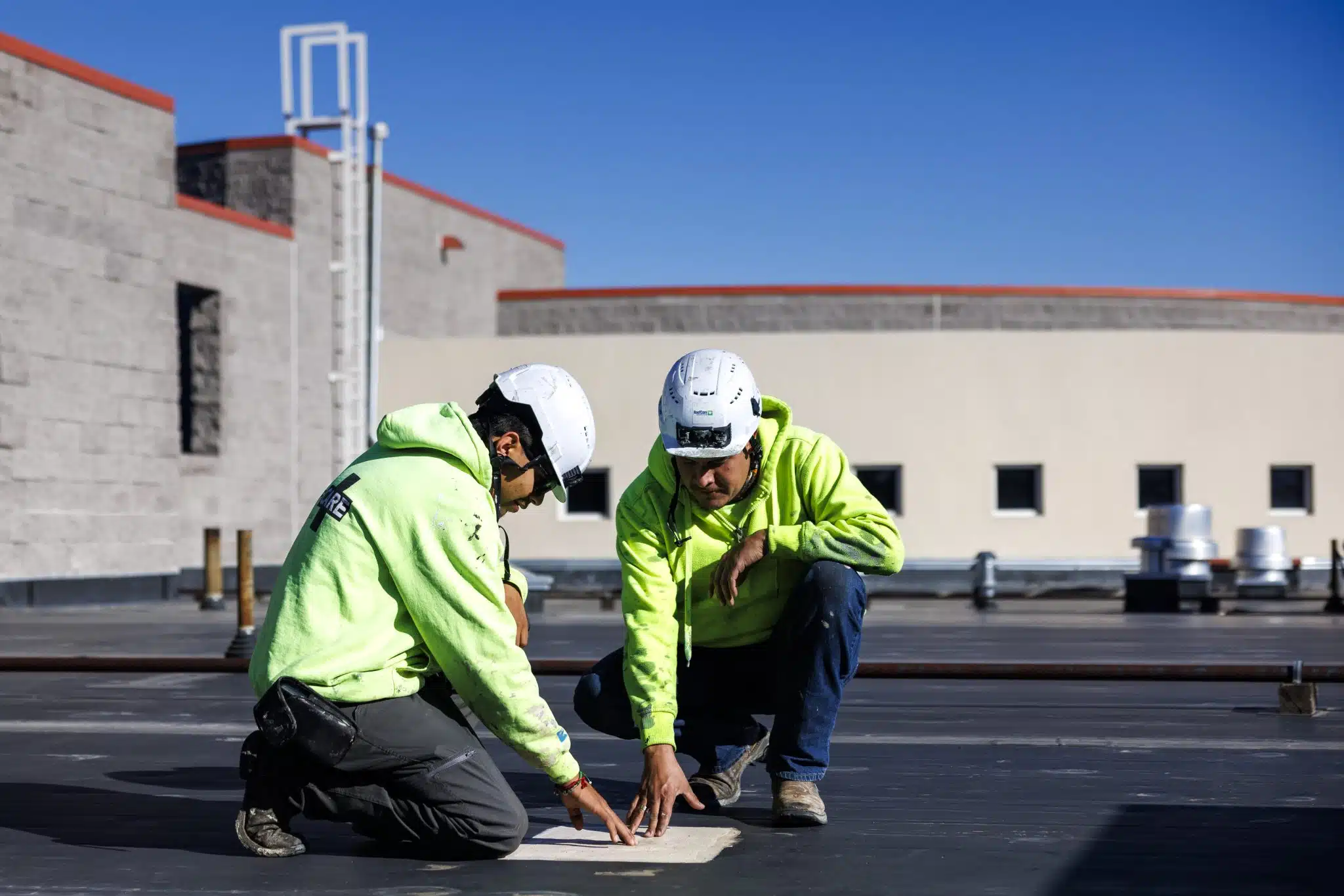
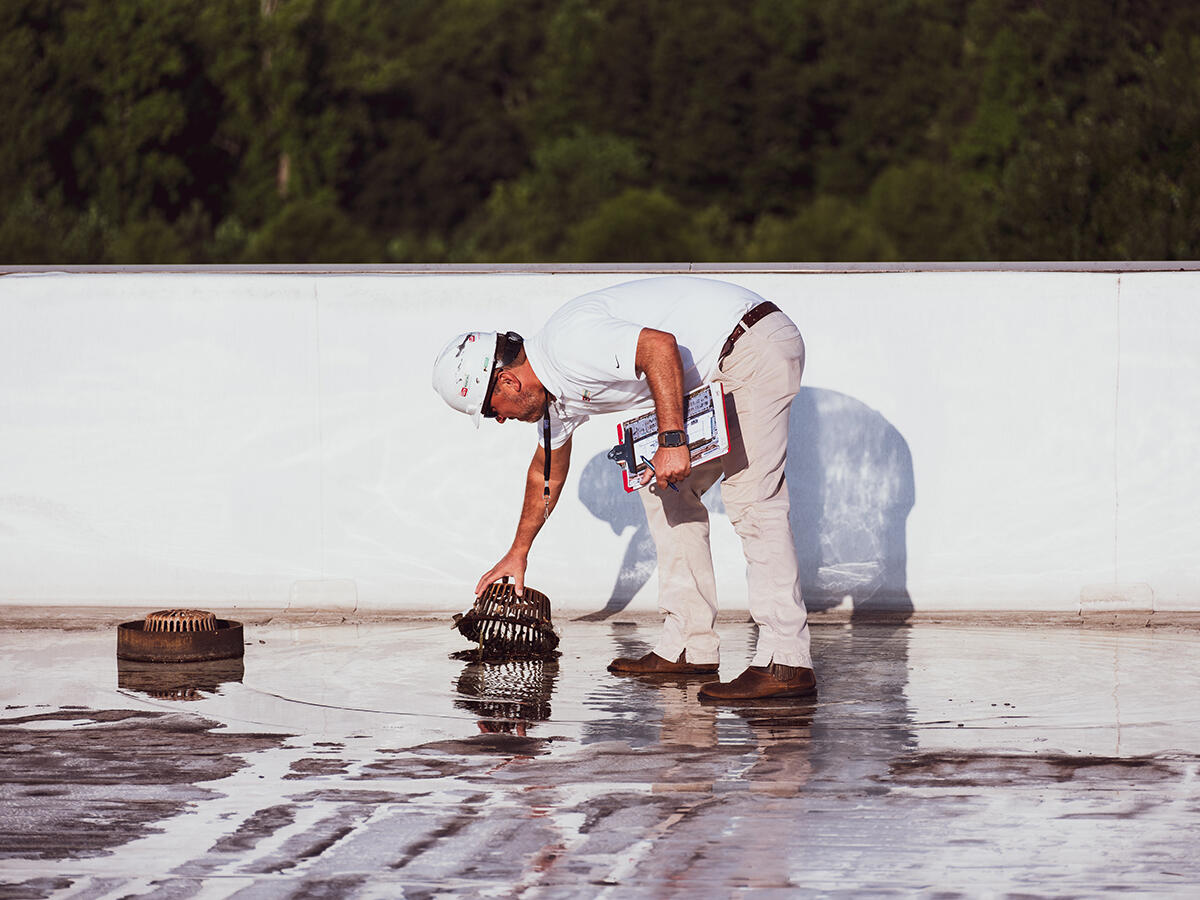
The roof walk starts at the identified interior leak zone and works outward. We look for the likely entry mechanisms in sequence: drain condition and drain surcharge potential, nearby parapet base flashing at inside corners and at penetrations, field seam condition within the zone, and any prior repair attempts that may have sealed one entry point while leaving an adjacent one open. We probe seams, check drains for flow, and identify any location where standing water can be present after a typical rainfall event.
Moisture core sampling confirms where the insulation has absorbed water. We pull cores at the interior leak location and at likely entry points identified by the roof walk. Core location, depth, and moisture level are photographed and logged. The gap between the core pull location and the interior drip location is typically where the horizontal migration is occurring, and identifying that gap helps scope the full repair - not just patching the entry point but replacing the saturated insulation that would otherwise continue releasing moisture into the building assembly over the following weeks.
Common Leak Sources on Raleigh Commercial Flat Roofs
Parapet inside corner flashing failure is the most common single-source leak we find on older Raleigh commercial buildings. Inside corners - where two parapet walls meet - concentrate runoff from both adjacent parapet faces, and the flashing at that location is under more thermal and moisture cycling stress than any other point on the roof. On buildings constructed in the 1990s and early 2000s with adhered base flashing, that corner bond often fails in year 10 to 15 without visible surface indication until a prolonged rain event drives water past the relaxed bond.
Drain collar failures are the second most common source. The roof drain collar - the flange that connects the membrane to the drain body - is a two-material assembly joint that can separate as the membrane ages and thermal cycling accumulates. A drain collar that is partially separated appears functional under a casual visual inspection but allows water to migrate under the membrane and into the insulation assembly around the drain.
HVAC curb flashing at equipment units is the third category we see regularly on Raleigh commercial buildings. Buildings in North Hills and Downtown Raleigh commercial corridors often have dense rooftop HVAC equipment footprints. Curb flashings that were inadequately detailed at installation - or that have separated from the membrane due to thermal movement at the curb face - allow water entry at penetrations that may be difficult to see from ground level but are visible and probe-testable on a roof walk.
Repair Scope and Interior Follow-Up
Leak repair scope on a Raleigh commercial flat roof addresses the entry point, the migration path, and the resulting insulation saturation. Entry point repairs vary by failure type: inside corner flashing replacement with mechanically fastened and welded flashing; drain collar replacement with manufacturer-specification collar and clamping ring; curb flashing replacement or reattachment with compatible sealant and reinforcing membrane. Each repair is executed to manufacturer installation specifications, not to a patched-over standard.
Insulation replacement at zones of confirmed saturation is part of the permanent repair scope. Leaving saturated insulation in place - even after sealing the entry point - creates ongoing moisture release into the building assembly as the insulation dries slowly over months. For some buildings where the moisture migration path crossed a large area, we recommend an infrared scan before committing to the insulation replacement scope so that the full saturation boundary is mapped before the contractor mobilizes.
Interior damage remediation - ceiling tile replacement, drywall patching, mold remediation where required - is outside our direct scope, but we coordinate with your facility manager or a remediation contractor to sequence the interior work after the roof is confirmed dry. Closing the ceiling before the roof has fully dried is a mold risk. We communicate the drying timeline based on insulation replacement scope and advise on re-inspection timing before interior closure.
Frequently asked questions
My Raleigh commercial building is dripping during every rain event. How quickly can you diagnose the source?
For active leak situations within the I-440 Beltline - Downtown Raleigh, North Hills, downtown mixed-use corridor - we can get a crew on-site for an emergency diagnosis walk within four business hours. Call 919-372-4890 directly. For outer Wake County locations, next-day mobilization is the standard. Bring us the interior damage location and recent rain history when you call - it helps us know what equipment to bring.
Does commercial property insurance cover active leak damage in Raleigh?
Coverage depends on cause. Sudden and accidental water intrusion tied to a specific storm event is typically covered. Gradual leak damage from a drain collar that has been separating for two years is typically excluded as maintenance deferred. Our diagnostic report documents the mechanism - whether it is event-related sudden failure or progressive condition - which is the information your adjuster needs to determine coverage applicability. We present the facts; we do not represent insureds in coverage disputes.
Can you repair a leak on a commercial building that is currently under a manufacturer warranty?
Yes - but the repair must be executed to the manufacturer's installation specifications if the warranty is to remain in force. We repair to manufacturer spec and document the repair work in a format that satisfies manufacturer warranty continuation requirements. Some manufacturer warranties require notification before third-party repairs; we will tell you if your system is on that list so you can notify the manufacturer before we begin.