Ponding water and insulation saturation are slow-moving failures on Raleigh commercial flat roofs. By the time the interior damage is visible, the insulation assembly may have been wet for months. We map the saturation, scope the repair, and address the drainage condition driving it.
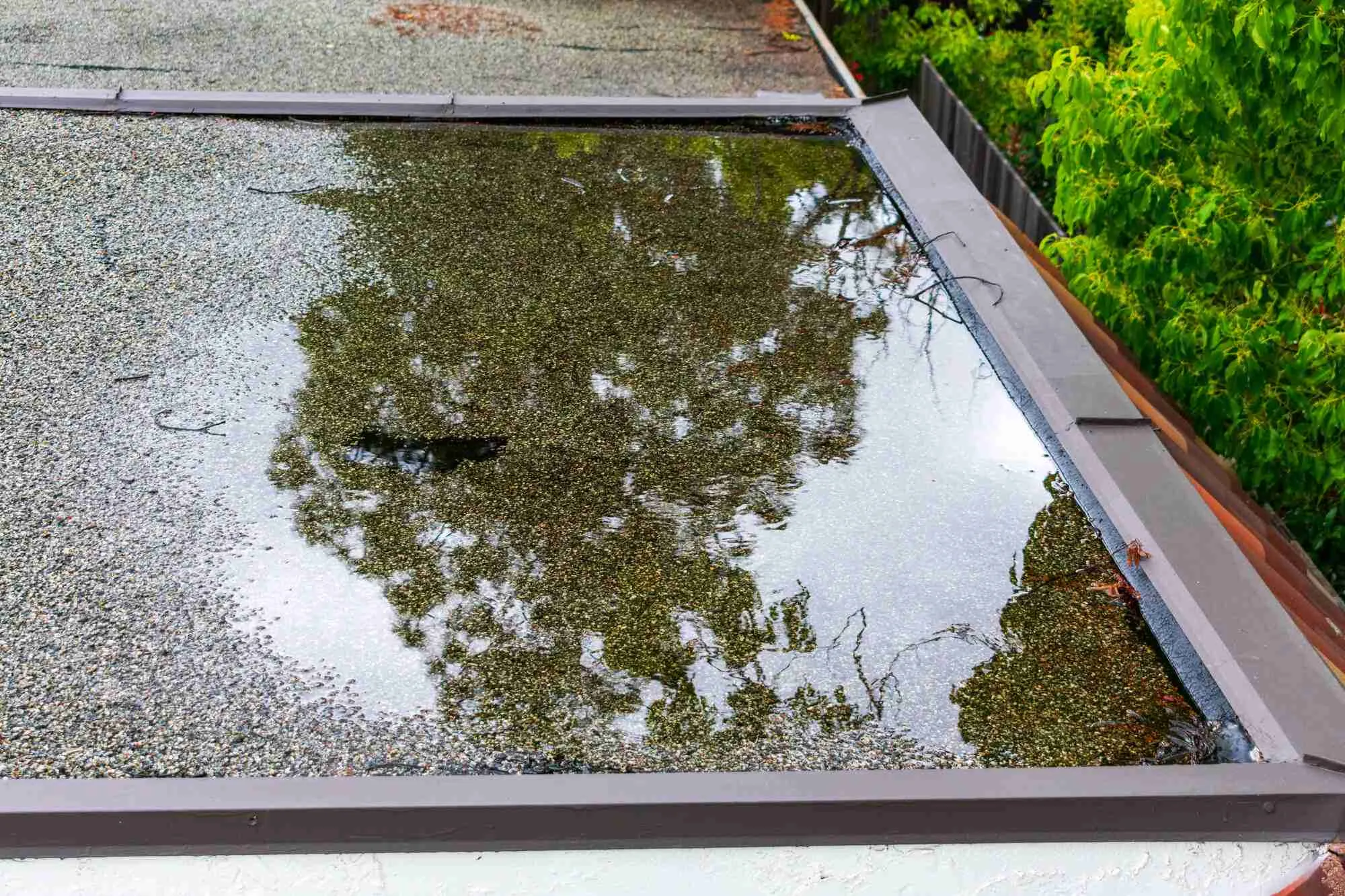
Water damage on a commercial flat roof is usually not a single event - it is the accumulated result of inadequate drainage creating ponding conditions that expose the same membrane locations to sustained water loading through multiple rain cycles. Raleigh's commercial building stock, particularly buildings constructed in the 1980s and 1990s before current drainage design standards, commonly presents with drain configurations that do not achieve positive drainage across the full roof field. Areas that pond for 48-plus hours after a rainfall event are areas where the insulation below the membrane is absorbing water through seam wicks, through compromised drain collars, and through any membrane imperfection that has opened under thermal cycling.
The Hurricane Florence remnant rainfall event in 2018 and the Hurricane Helene remnant moisture event in 2024 both turned latent ponding problems into acute water damage events on Raleigh commercial flat roofs. Buildings that had ponds that sat for 24 to 36 hours under normal summer storm conditions had ponds that sat for 96 hours or more under Florence and Helene's rainfall totals - long enough to drive water past seams and flashings that had previously held against shorter-duration rain. The post-event moisture surveys we conducted after both storms consistently found insulation saturation extending far beyond the interior damage footprint.
Water damage repair requires a moisture survey to establish the saturation boundary before committing to a repair scope. Repairing the surface without replacing the saturated insulation leaves wet material that continues releasing moisture into the building assembly over weeks or months. We scope water damage repairs based on what the moisture survey shows, not on the visible surface condition.
Identifying Water Damage: Core Sampling and Infrared Survey
Moisture core sampling is the baseline method for confirming and locating insulation saturation on a Raleigh commercial flat roof. We pull three-inch diameter cores at suspect locations - typically in drainage low points, at and around interior drip locations projected onto the roof plan, and at any parapet inside corner or penetration where entry is suspected. Core condition - wet insulation, corroded deck facer, water-discolored board - is photographed and logged by roof zone.
Infrared (IR) scanning is the large-area method. An IR scan performed at dusk, when the sun has set and the roof surface has begun to cool, detects the temperature differential between wet insulation (which cools more slowly than dry insulation) and dry areas. An IR scan can map saturation boundaries across a large roof in a single survey pass. The limitation of IR scanning is that it requires a significant temperature differential and a dry surface - a roof that was rained on within the past 24 hours or that has standing water does not produce a valid IR scan. We schedule IR surveys on dry-weather days following the post-event dry period.
Capacitance moisture meter scanning is the third method - useful for smaller roof areas or for confirming IR results in targeted zones. A calibrated capacitance meter probes insulation moisture content through the membrane surface. The method is slower and more labor-intensive than IR scanning but does not depend on temperature differential, making it useful in shoulder-season conditions where the temperature delta between wet and dry insulation is insufficient for reliable IR.
Drainage Analysis and Remediation
Water damage on a commercial flat roof driven by inadequate drainage requires addressing the drainage condition as part of the repair scope - not just replacing the saturated insulation while leaving the drainage problem unchanged. Replacing insulation in a chronic ponding zone without improving drainage is a repair that will repeat itself in 3 to 5 years.
Drainage improvement options depend on the building and the severity of the ponding condition. Drain additions - cutting new drains into the deck at low points and connecting them to the building's internal drainage system - are the most effective solution but require coordination with the building's plumbing contractor and structural review at the new penetration locations. Tapered insulation crickets installed at ponding low points to redirect flow to existing drains are an effective alternative when drain addition is not feasible. Scupper additions at parapet walls are the overflow-relief option for buildings with chronic ponding near parapet edges.
For commercial buildings in the Downtown Raleigh core where the plumbing system runs through occupied floors and drain additions are complex or disruptive, we scope the solution that achieves the maximum drainage improvement with minimum interior disruption - typically a combination of tapered crickets and overflow scupper additions that address the immediate ponding risk without requiring interior plumbing work.
Repair Scope After Water Damage
Water damage repair scope is determined by the moisture survey results. The scope covers: insulation replacement at all zones where cores or scanning confirmed saturation above the threshold for functional compromise; deck replacement at any deck area where core pulls revealed corrosion or structural deterioration; membrane repair or replacement over the insulation replacement zones; drain collar replacement at any drain collar that showed evidence of separation; and flashing replacement at any entry point identified in the diagnostic walk.
The repair sequence matters. We replace insulation and deck before re-membraneing. We do not attempt to membrane over wet insulation on the theory that it will dry out - it will not dry out under a closed membrane, and the saturated insulation will continue to affect the new membrane's adhesion and thermal performance until it is replaced.
Closeout documentation after a water damage repair includes moisture core results confirming dry condition at the repair boundaries, photographs of each replaced insulation zone, and written confirmation that the membrane installation over the replacement zones was executed to manufacturer specification. That documentation is what a manufacturer requires to maintain warranty coverage over the repaired area.
Frequently asked questions
How do I know if my Raleigh commercial roof has insulation saturation without visible interior damage?
The absence of interior damage does not mean the absence of insulation saturation. Saturation in the insulation layer does not become visible inside the building until the water migration path reaches the interior membrane, which can take weeks or months after the initial entry. The indicators that warrant a moisture survey are: persistent ponding after rain events; a history of intermittent interior drips that stop and start; a roof that has not been core-sampled since the 2018 or 2024 major rain events; or a roof that is approaching 15-plus years of age without a documented condition assessment.
Is a moisture survey part of the standard roof assessment before a capital planning decision?
Yes - or it should be. A capital decision on a Raleigh commercial roof made without moisture survey data is a decision made on incomplete information. If more than 25% of the insulation is saturated, recover options are off the table and replacement is the only sound scope. If saturation is under 25%, targeted insulation replacement in combination with a recover can extend the asset at a fraction of the full replacement cost. The moisture survey is the data that makes that decision defensible.
How much does insulation saturation increase the cost of a commercial roof repair?
It depends on the saturation footprint. If moisture cores show saturation in a limited zone around a single failed drain collar, insulation replacement at that zone adds one to two days of labor and materials to the scope. If a full moisture survey reveals saturation across 40% of a 50,000 sq ft roof field, the insulation replacement scope is the dominant cost item and likely tips the economics toward full replacement rather than repair. We present the moisture survey data and the repair-versus-replace economics in writing before you commit to a scope.