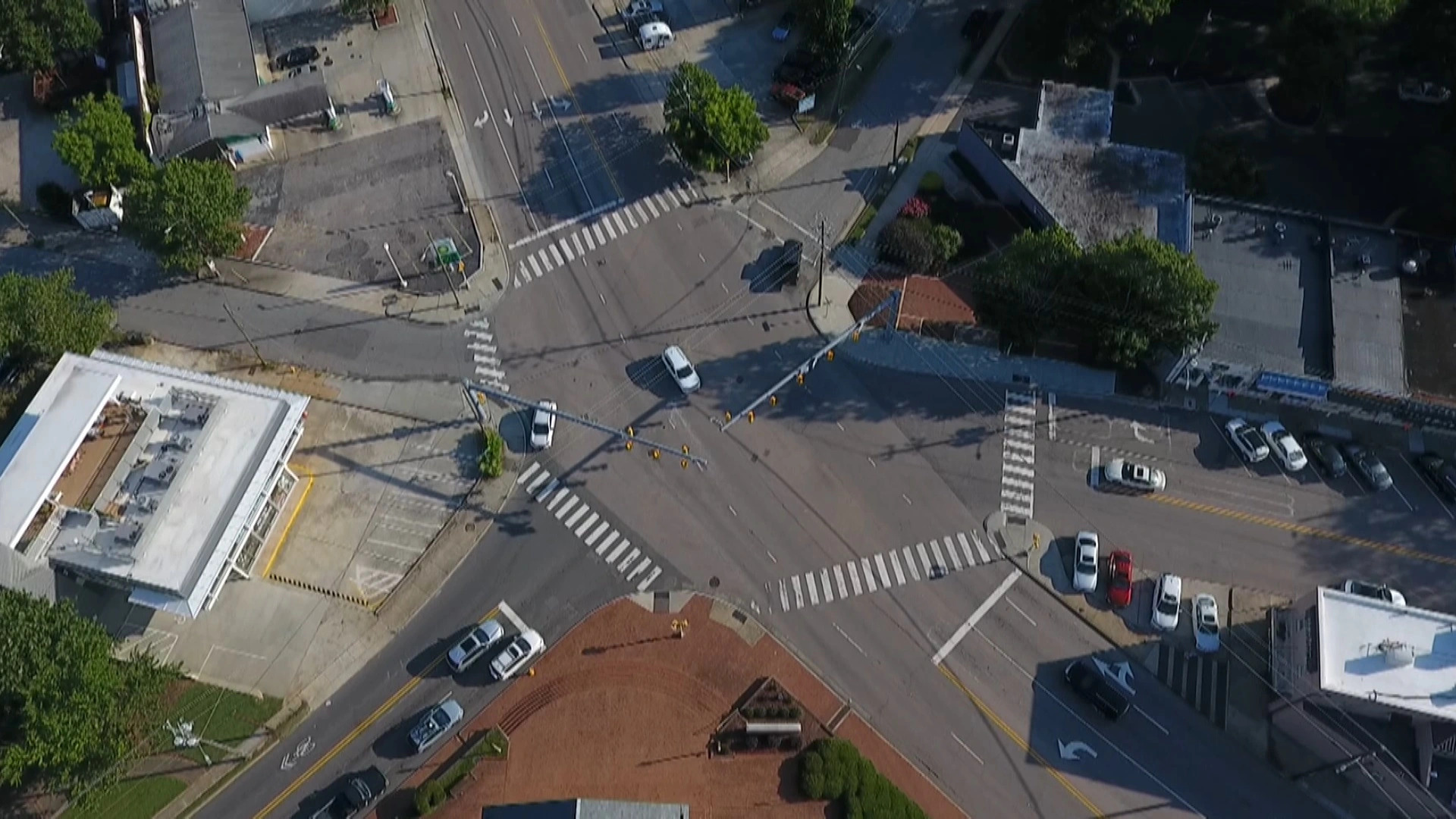
Five Points is where Glenwood Avenue, Fairview Road, and Whitaker Mill Road converge north of Downtown Raleigh - a historic neighborhood commercial cluster with building stock that ranges from 1920s brick to post-1990s infill. The roofing challenges here are specific.
Five Points is one of Raleigh's most recognizable neighborhood commercial districts - the five-street convergence of Glenwood Avenue, Fairview Road, Whitaker Mill Road, Lassiter Mill Road, and Peace Street creates a commercial node that has served the surrounding neighborhood for nearly a century. The buildings here are not a monolith: you have 1920s and 1930s brick commercial buildings with flat roofs and stone copings, 1950s and 1960s low-rise retail strips, 1990s infill mixed-use buildings, and recent adaptive reuse projects that have turned old industrial and service buildings into restaurants and offices.
That building diversity is what makes Five Points interesting to work in. A 1930s brick commercial building with a flat-top parapet and a stone coping cap presents a completely different set of inspection findings than a 1998 mixed-use building three doors down. Both need specific expertise - the historic building needs someone who understands parapet moisture migration and historic masonry, the newer building needs someone who can assess whether a ten-year-old TPO system has reached the recover-versus-replace inflection point.
We have worked on buildings throughout the Five Points district and the surrounding corridor - the Roanoke Park and Bloomsbury neighborhoods to the west, the Anderson Drive commercial strip to the east. The buildings in this area are typically smaller-footprint than the major commercial corridors, but the combination of age, mixed ownership, and sometimes-deferred maintenance makes thorough inspection and honest documentation more important here than on a new corporate campus where the building history is clean.
Historic Brick Commercial Buildings at the Five Points Intersection
The buildings immediately at the Five Points intersection - the commercial strip along Glenwood Avenue from Peace Street north to Lassiter Mill Road - include some of the oldest continuously occupied commercial real estate in northwest Raleigh. Many are two-story or three-story brick buildings with flat roofs, stone or cast-concrete coping caps, and parapet walls that have absorbed a century of Raleigh weather cycles.
The primary failure mode on these buildings is not usually the roof membrane - it is the parapet. Stone copings that have lost their mortar joints allow water to migrate into the parapet wall assembly, which then tracks down into the roof membrane termination, bypasses the flashing, and shows up as an interior leak that looks like it comes from the roof. We document parapet condition separately from membrane condition in our inspection reports because the repair scope is often different: masonry tuckpointing and coping reseating are a mason's work, not a roofer's work, but the two scopes need to be coordinated or the new membrane installation will fail at the same points as the old one.
Many of the Five Points historic buildings have had their flat roofs modified over the decades - added mechanical curbs, added skylights, abandoned penetrations that were patchwork sealed rather than properly restored. A thorough inspection of these buildings often reveals a palimpsest of repair generations that needs to be mapped before any replacement scope can be accurately priced.
1990s and 2000s Infill Commercial Buildings
The infill commercial buildings scattered through the Five Points district - built primarily during the 1990s and early 2000s on vacant lots or as replacements for demolished earlier buildings - are at a different lifecycle point. These buildings have TPO, EPDM, or modified bitumen flat roofs that were standard commercial specification at the time of construction and are now 20-25 years old. Many have been maintained by patch repair rather than systematic maintenance programs.
The challenge with 1990s commercial construction in Five Points is documentation. These buildings often changed hands multiple times since original construction, and the roofing maintenance history is a stack of invoices with no systematic record of what was replaced, what was patched, and what was never addressed. We start every engagement on a building with an unknown maintenance history with a systematic inspection - roof core samples to assess insulation saturation, a photo log keyed to a roof zone diagram, and written documentation of all identified conditions. That documentation is the foundation for the replace-versus-recover decision and for the capital plan that follows.
Restaurant and food service tenants are heavily concentrated in the Five Points commercial district. A roof failure over a food service kitchen is not just a maintenance problem - it triggers health department notification requirements and can shut down an operation. Landlords in Five Points with food service tenants below their rooftop have a specific risk profile that makes systematic maintenance more defensible as an operating decision.
Anderson Drive Corridor and Surrounding Neighborhood Commercial
Anderson Drive, running east from Five Points through the Bloomsbury and Roanoke Park neighborhoods, carries a strip of neighborhood commercial development - small office suites, veterinary practices, auto service, and neighborhood retail. These buildings are predominantly small-footprint (under 10,000 square feet) single-story commercial construction that presents a different scope profile than the larger Five Points core buildings.
Small commercial buildings in the Anderson Drive corridor are typically owner-occupied or managed by individual landlords, not institutional asset managers. The decision-making process is more direct - the owner is usually the one we talk to - but the capital planning discipline is often less developed. We provide the same documented inspection reports and capital planning recommendations for small commercial buildings that we provide for institutional clients; the format is the same, the value is proportional to the building owner's capital at stake.
The Whitaker Mill Road corridor north of Five Points - running toward the North Hills boundary - has seen increasing mixed-use activity as restaurants and professional services move into buildings that were previously auto-oriented service commercial. Adaptive reuse projects in this corridor often involve changes to the rooftop condition that were not permitted or properly documented - added skylights, new HVAC penetrations, modified drainage. We factor those undocumented changes into our inspection scope.
Frequently asked questions
Can you handle the historic brick commercial buildings at Five Points - the older buildings with parapet walls and stone copings?
Yes. Parapet moisture migration and coping cap failure are the most common inspection findings on older brick commercial buildings. We document parapet condition separately from membrane condition and coordinate with masonry contractors when the repair scope requires tuckpointing or coping reseating before a new membrane installation will hold.
My Five Points building has a food service tenant. How does that affect roofing work timing?
Food service tenants are sensitive to two things: interior leak risk during work and HVAC disruption during service hours. We dry-in the building at the end of each production day, never leaving the building exposed overnight. HVAC work over a kitchen space gets scheduled for early morning before prep begins or after close. We coordinate directly with the tenant's operations schedule.
I own a small commercial building in the Five Points area. Is it worth getting a documented inspection?
Yes. A documented inspection is the only way to make a defensible decision between patching, recovering, or replacing - and on smaller buildings, the difference between those three paths can be material to your operating budget. We provide full inspection reports and capital planning recommendations for buildings of all sizes.