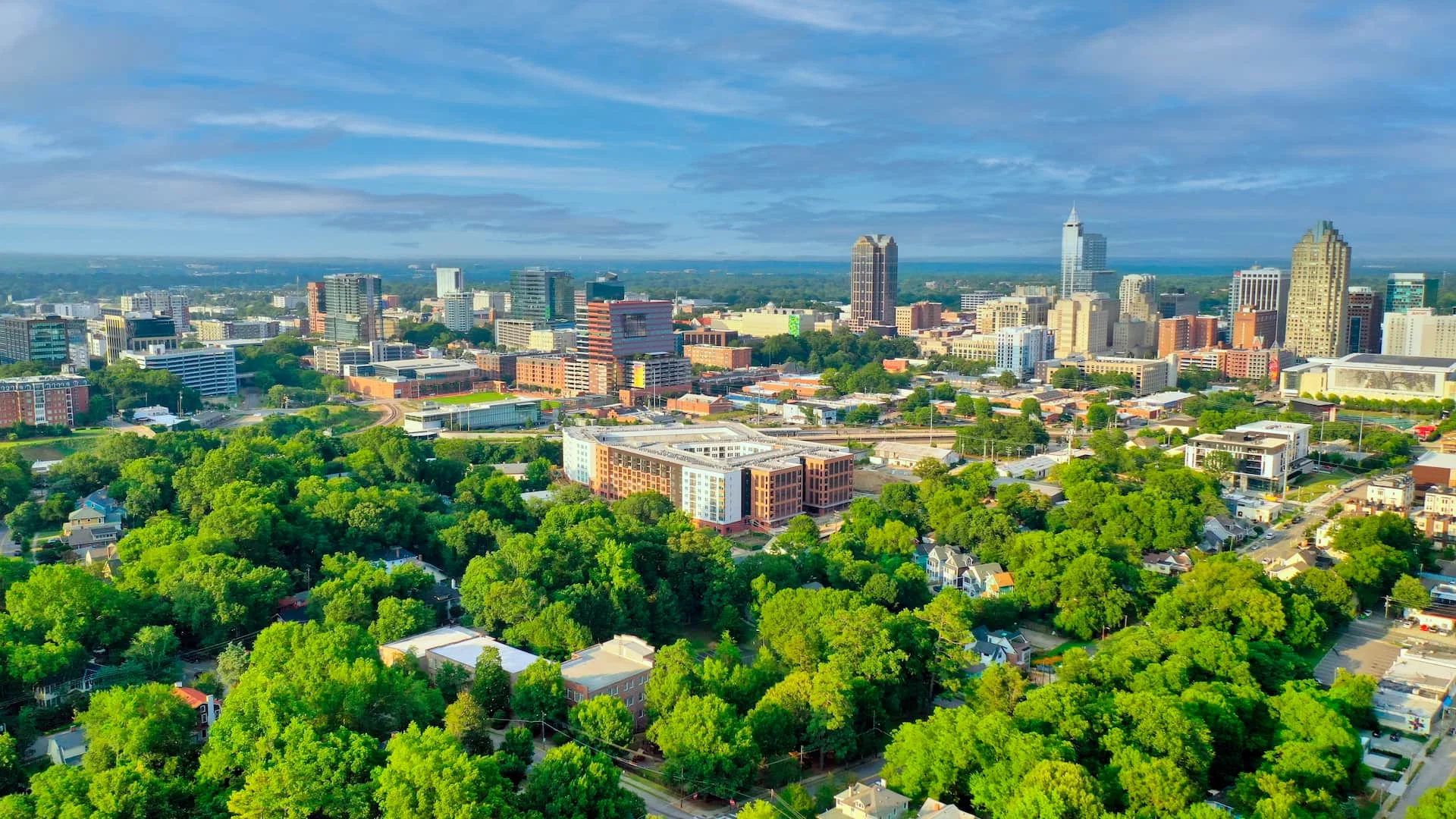
West Raleigh is powered by Raleigh campus University's main campus on Western Boulevard and Centennial Campus on Lake Wheeler Road - a 1,334-acre research park that houses more than 70 companies and state agencies, along with an expanding ring of commercial development along the I-40 western corridor.
West Raleigh occupies the territory between the Raleigh campus University campus on Western Boulevard, the I-440 Beltline to the north and east, and the I-40 corridor to the south. The defining institutional presence is Raleigh campus - both the main campus and, more relevant to our commercial work, the Centennial Campus research park on Lake Wheeler Road and Avent Ferry Road. Centennial Campus is one of the more unusual commercial real estate environments in the Triangle: a planned research park where corporate tenants, startups, state agencies, and university research labs share a campus designed for collaboration.
The buildings on Centennial Campus are predominantly post-1990 construction - the campus broke ground in 1991 and has been in continuous expansion since. Many buildings are purpose-built for research and laboratory use, with rooftop exhaust systems, specialized ventilation equipment, and increasingly, building-integrated photovoltaic arrays as part of the university's sustainability commitments. These buildings are categorically different from standard commercial office buildings in terms of what a roof inspection needs to cover and what a replacement scope needs to specify.
Beyond Centennial Campus, the commercial development along Western Boulevard, Avent Ferry Road, and the US-1 / I-40 interchange represents the western edge of Raleigh's suburban commercial fabric - a mix of neighborhood retail, professional office, industrial, and logistics buildings that serves the Cary-adjacent western Wake County market.
a Raleigh research campus - Research Buildings and Institutional Work
Centennial Campus buildings present a specific roofing inspection and replacement challenge: the rooftop equipment density. A typical Centennial Campus research building has multiple laboratory exhaust stacks, make-up air units, chiller equipment, condensing units, communication infrastructure, and - with increasing frequency - building-integrated photovoltaic arrays. The penetration count per square foot of roof surface is far higher than a standard commercial office building, and each penetration represents both a potential flashing failure point and a constraint on where and how new membrane work can be staged.
Raleigh campus's institutional procurement process requires licensed contractors, documented insurance with university-specified limits, and adherence to Raleigh campus's design standards for roofing work. The university's facilities management division maintains building records and capital planning databases that track roof condition and warranty status - we deliver closeout documentation in formats compatible with the university's asset management systems.
Rooftop photovoltaic array work on Centennial Campus buildings requires coordination with a licensed electrical contractor for disconnection and re-commissioning. We identify PV arrays during pre- This is not optional coordination - the manufacturer warranty inspection requires that all penetrations and curb assemblies are complete before the field rep signs off.
Western Boulevard and Avent Ferry Commercial Corridor
The Western Boulevard corridor - from the Raleigh campus main campus boundary west toward the Cary line - carries a mix of neighborhood commercial buildings, strip retail, and professional office that serves the dense commercial neighborhoods on either side of the corridor. The building stock ranges from 1960s and 1970s strip commercial to post-2000 professional office infill. This is a more typical neighborhood commercial environment than the Centennial Campus institutional work - the buildings are smaller, the ownership is more fragmented, and the maintenance history is more variable.
Avent Ferry Road running south from Western Boulevard toward the Lake Wheeler Road corridor serves a different set of uses: commercial-adjacent neighborhood commercial at the northern end transitioning to industrial and warehouse uses near the I-40 interchange. The industrial buildings along Avent Ferry near I-40 are a mix of light manufacturing, distribution, and the food production facilities associated with the nearby Wake County food corridor. These buildings have different roof profiles than office buildings - simpler geometry, higher internal humidity in some cases, and more demanding ventilation penetration conditions.
The US-1 / I-40 interchange area in southwest Raleigh is a growing industrial and logistics zone - a natural extension of the Cary Crossroads and Apex distribution centers along the US-1 corridor. Buildings in this zone have expanded through the 2010s and 2020s as the Triangle's e-commerce and distribution economy has grown. Large-footprint low-rise buildings in open terrain near the I-40 / US-1 interchange require the same wind-uplift treatment we specify for comparable buildings in the Brier Creek I-540 corridor.
Lake Wheeler Road Research and Government Corridor
Lake Wheeler Road runs from the Centennial Campus boundary south toward the Garner line, passing through a corridor that includes state government research facilities, Raleigh campus research annexes, and the Lake Wheeler Road environmental complex. This is a specialized institutional corridor with buildings that house environmental research, animal science, and agricultural research - uses that create unusual roofing conditions including high indoor humidity, specialized ventilation penetrations, and in some cases animal welfare considerations that shape how and when rooftop work can be scheduled.
State government facilities on Lake Wheeler Road run through NCDOT and NC Department of Administration procurement processes for construction work, which involves competitive bidding, certified payroll, and documentation requirements that differ from private commercial work. We have experience with state procurement documentation requirements and can deliver the paperwork the state agencies need for project closeout.
The commercial development pressure in West Raleigh - particularly the growth of the Cary-adjacent neighborhoods along US-1 south - is driving new commercial construction in the zone. New retail and mixed-use development on Avent Ferry Road and at the I-40 / US-1 interchange represents new-construction roofing work that requires proper new-construction spec review and warranty registration from day one.
Frequently asked questions
Do you have experience with a Raleigh research campus institutional procurement requirements?
Yes. Raleigh campus institutional procurement requires specific insurance limits, licensed contractor documentation, and closeout documentation in formats compatible with the university's facilities management systems. We have delivered roofing projects within Raleigh campus procurement requirements and can provide the documentation the facilities division requires.
How do you handle buildings with rooftop photovoltaic arrays on Centennial Campus?
PV array work is a pre-construction coordination item. We identify arrays during the inspection phase, coordinate disconnection with a licensed electrical subcontractor before membrane work begins, provide temporary protection for panels during the roofing work window, and confirm re-commissioning before the manufacturer's warranty inspection. The electrical sub schedule is built into the project timeline from day one.
I have a small commercial building on Western Boulevard, not a big campus. Do you take small projects?
Yes. Neighborhood commercial buildings on Western Boulevard, Avent Ferry, and the surrounding west Raleigh corridors are part of our regular service area. The inspection report and capital planning deliverable is the same regardless of building size - you get documented findings and a written recommendation, not a verbal estimate.