Property Type
Roof replacement, repair, and maintenance for multifamily commercial buildings across Raleigh and the Triangle - Downtown towers, North Hills mixed-use mid-rise, and Cary garden-style complexes - scoped around occupied residents and property management operations.
Multifamily roofing in the Raleigh market covers a wide building typology. The Downtown Raleigh apartment towers that have risen along the Peace Street and Hillsborough Street corridors - buildings like the Edison at Midtown, the Dillon, and the wave of twelve- to twenty-story towers reshaping the skyline west of the Capitol - carry steel-frame construction with flat membrane roof sections, significant rooftop mechanical equipment, and amenity deck configurations that require waterproofing assemblies distinct from the field membrane.
North Hills' mid-rise mixed-use buildings along Six Forks Road represent a different multifamily segment - four to eight story wrap configurations with podium parking and rooftop amenity decks that have become a defining feature of the Midtown commercial market. These buildings are more architecturally complex than garden-style and carry more roof interface conditions - mechanical penthouses, amenity terraces, parking deck waterproofing - that require careful scope separation.
Cary's garden-style apartment complexes - distributed across the Crossroads, Weston, and Preston Road corridors - are the most straightforward multifamily roof type in square footage terms, but they involve a different coordination challenge: inhabited units directly below the roof deck on every building, with residents who are home during production hours and who have the expectation that their unit will remain dry and undisturbed throughout the project.
Downtown Raleigh Apartment Towers
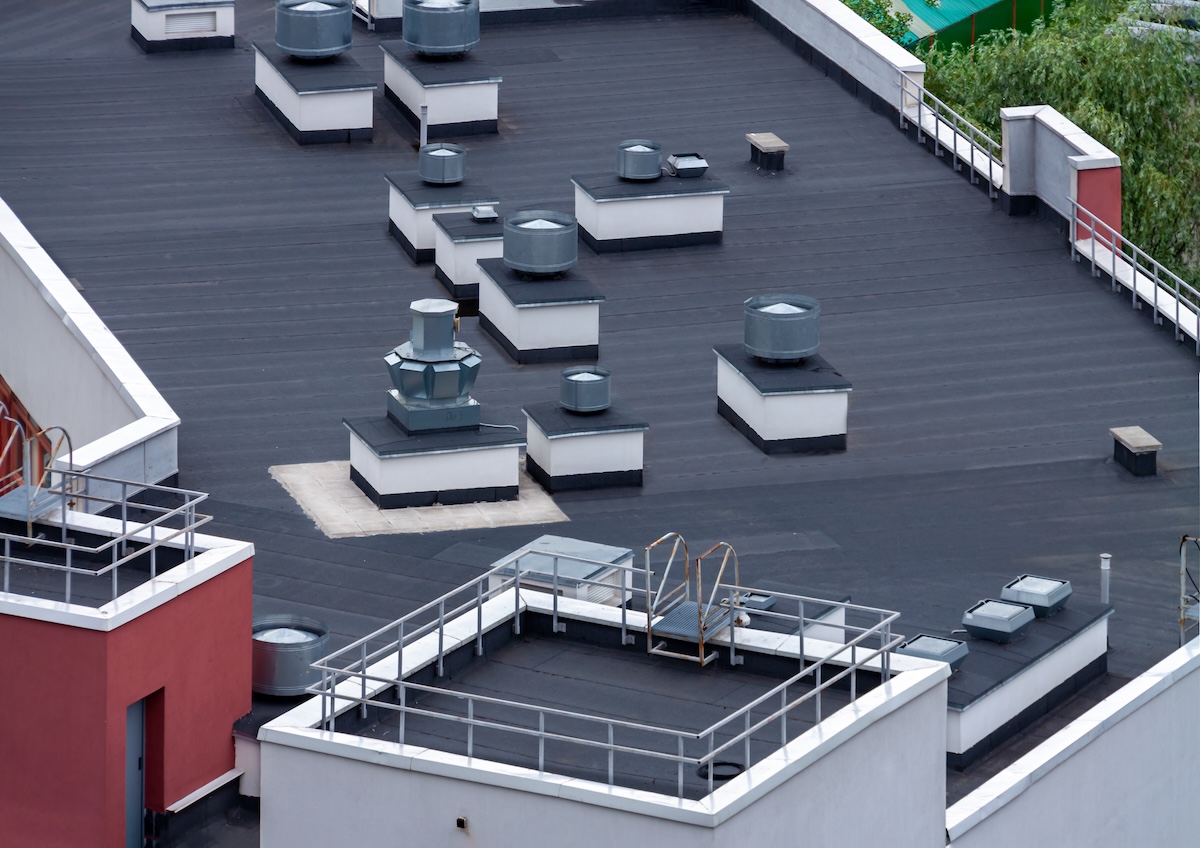
The Downtown Raleigh apartment tower market has grown faster than any other multifamily segment in Wake County. Buildings along the Hillsborough Street/Peace Street corridor, the downtown mixed-use corridor commercial towers, and the Warehouse District conversion projects bring high-rise and mid-rise commercial configurations to the urban core. Most carry TPO or PVC membrane systems on the main roof field, with protected membrane assemblies under rooftop amenity decks and PVC-lined planters and drainage features.
Rooftop amenity decks on Downtown apartment towers are among the most demanding waterproofing conditions we encounter. A rooftop pool deck or lounge area with a finished paver or composite surface over a waterproofing membrane has more interface conditions - deck drains, parapet coping, built-in furniture anchors, lighting penetrations - than a plain commercial flat roof of the same footprint. When those interfaces fail, the water path to the occupied commercial units below can travel a significant lateral distance before appearing as a visible leak, making source identification difficult without a systematic inspection approach.
Crane access for Downtown tower roof projects requires right-of-way coordination with the City of Raleigh. For buildings on Glenwood Avenue, Peace Street, or Hillsborough Street, street closure and crane permits are a multi-week lead-time item. We begin permit applications as soon as the scope is scoped and signed, not after mobilization is scheduled.
North Hills Mid-Rise and Mixed-Use Buildings
North Hills' commercial mid-rise buildings - the apartment and condominium components of the Kane Realty development and the independent mixed-use towers that have followed along the Six Forks Road and Lassiter Mill corridors - carry the same amenity deck complexity as Downtown towers at a lower height, but often with more complicated roof geometry. Wrap buildings with interior courtyards create waterproofing interfaces at the courtyard level that are distinct from the main roof field. Podium parking decks below commercial floors require waterproofing systems designed specifically for vehicular loading.
The North Hills area also has a significant concentration of 1990s and 2000s vintage garden-style and low-rise multifamily buildings that are approaching the end of their original or first-recover roof systems. These buildings - in the Morrisville Road, Strickland Road, and Lead Mine Road corridors north of I-440 - are candidates for either recover or full replacement depending on insulation saturation conditions. We have walked many of these roofs on inspection calls from property managers dealing with recurring leak complaints.
Property management companies overseeing multiple North Hills or North Raleigh apartment communities benefit from a portfolio-level inspection approach - a single engagement that documents the condition and remaining service life of every building's roof in the portfolio, so capital reserves can be allocated against a documented asset condition rather than an estimated one.
Cary Garden-Style Complexes and Resident Coordination
Garden-style apartment complexes in Cary - distributed across the Crossroads, Cary Parkway, and Regency Parkway corridors - typically involve clusters of two- to four-story buildings with gabled or low-slope roofs, each building containing eight to twenty-four units. Resident coordination is the primary management challenge on these projects: residents are home during the day, they hear everything happening on the roof above them, and the property management company has a legal obligation not to create habitability issues during construction.
We provide a resident notification letter template to the property management team before mobilization, describing the scope of work, the production schedule by building cluster, the daily working hours, and the emergency contact number for a resident to report an active leak or other urgent condition during construction. That letter goes out at least 72 hours before work begins on each building. Residents in units directly below active tear-off zones get individual outreach from the property manager.
Dry-in protocol on garden-style multifamily is absolute. Every unit in a building must be under dry-in cover before the crew demobilizes for the day - no partial sections, no end-of-day tarps over open sections. The production pace is planned against the dry-in requirement, not the tear-off rate.
Frequently asked questions
How do you handle rooftop amenity deck waterproofing on a Downtown apartment tower?
Rooftop amenity decks require a protected membrane assembly distinct from the field membrane on the building's main roof sections. The waterproofing membrane - typically a hot-applied rubberized asphalt or a fluid-applied system, depending on the deck configuration - goes down before the insulation and pavers, with drain bodies and perimeter flashing details installed as part of the waterproofing scope. We assess the existing assembly condition, identify any failure points in the existing waterproofing layer, and specify the appropriate repair or replacement system based on the deck's geometry, drain configuration, and the building's remaining structural capacity.
What notice do residents of a Cary garden-style complex receive before roofing starts on their building?
We recommend a minimum 72-hour advance notice to residents in the building being worked, with a description of the scope, the daily work hours, and an emergency contact number. The notice should be distributed by the property management company, not the roofing contractor - residents have a relationship with property management, not with us. We provide a draft notice template that property management can use as a starting point. If a unit is directly below the active tear-off zone, we recommend a follow-up individual outreach the morning of work on that section.
Our apartment complex in North Hills has multiple buildings with different roof ages. How do you prioritize?
A portfolio inspection assigns each building a condition score and a remaining service life estimate. We then prioritize by two factors: buildings with active leaks or documented water intrusion events go first, and buildings with less than three years of estimated remaining service life go second. The goal is a capital-planning roadmap that lets the property management company reserve against actual conditions rather than an age-based assumption. If a building with a ten-year-old roof has healthy insulation and sound seams, recovering it costs roughly half of full replacement - that decision should be based on documented condition, not the assumption that ten years means it is time.