
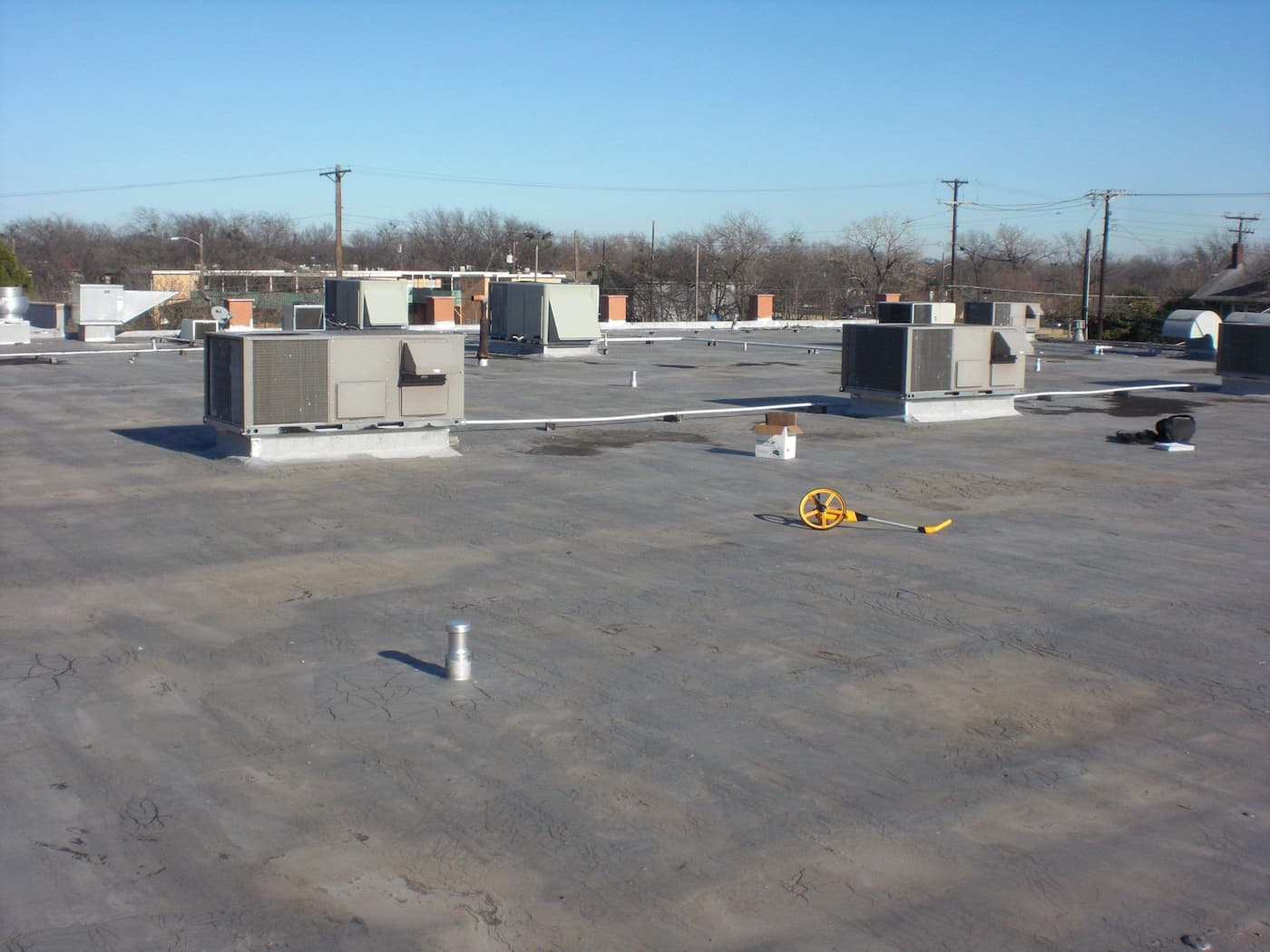
Hail damage on a commercial flat roof is not always visible from the ground or obvious in a casual surface walk. We assess, document, and repair membrane damage to a standard that holds up in an insurance claim or a warranty-dispute context.
Hail events in the Triangle are not unusual. The Carolina Piedmont sits inside a storm corridor that generates significant convective activity from spring through early fall, and hail-producing storms track through Wake County with enough regularity that any commercial building owner who has been in the market for more than a decade has likely experienced at least one meaningful event. What is unusual is getting the damage documented correctly.
Hail damage on commercial single-ply membranes presents differently than on commercial shingles. On TPO and EPDM, hail impact produces dimpling and, in larger-hail events, punctures that are not always visible in a casual surface walk - especially if the membrane has had time to partially recover its surface texture in the weeks after the event. Waiting too long after an event, or sending someone to do a visual check without knowing what to look for, produces an inspection that misses actual damage.
We assess hail damage against a documented protocol: we identify impact marks, measure dent depth and diameter at representative locations, probe for punctures, and inspect the seams around any impacted areas for stress-related separation. Every impacted zone is photographed with a scale marker and keyed to a roof zone diagram. The result is a damage document that distinguishes hail-related damage from pre-existing condition - the distinction that matters if a claim is filed.
How Hail Damages Commercial Flat Roofs
Single-ply membranes - TPO, EPDM, PVC - respond to hail impact based on the hail size and the membrane thickness and age. Hail at one inch or larger can puncture standard 45-mil and 60-mil single-ply membranes on contact, particularly if the membrane has become stiff with age or if the underlying cover board has been softened by prior moisture exposure. Hail below one inch on a sound 60-mil or 80-mil system typically produces dimpling without full puncture, but the dimples create stress concentrations in the membrane that accelerate future splitting under thermal cycling.
Modified bitumen and BUR systems respond differently - the granule surface on a torch-down or APP-modified bitumen system shows hail impact as granule displacement and bruising, similar to the commercial shingle damage pattern. Hail that displaces granule cover exposes the asphalt mat below to accelerated UV degradation, which shortens the membrane's useful life even if no immediate leak results.
Rooftop equipment is often the first signal of a hail event. HVAC unit housing dents and condenser fin damage are visible from a rooftop walk and correlate well with hail size and intensity. On Raleigh commercial buildings where the HVAC system is ground-visible from the street, we often get calls after building managers notice condenser damage - the roof assessment follows because the same event that damaged the HVAC may have damaged the membrane.
Documentation to Insurance-Grade Standard
Hail damage documentation for a commercial roof insurance claim requires more than a contractor's letter saying the roof looks damaged. Adjusters and, in contested claims, engineering consultants evaluating the damage need a documented record that identifies impact locations, measures impact characteristics, distinguishes fresh damage from weathered pre-existing marks, and maps the damage pattern against the storm track.
Our hail damage inspection reports include: a roof zone diagram with impact locations marked and numbered; photographs of each documented impact with a scale marker; impact diameter and depth measurements at representative locations; a membrane condition assessment that notes the age and prior repair history of the system; and a written analysis of the damage pattern relative to the hail storm's documented track and intensity.
We correlate our field findings with NOAA storm data - hail size, storm track, and event timing - and with property claims weather data services when the claim requires it. The combination of field documentation and weather data correlation is what separates a defensible damage report from an unsupported claim that an adjuster can decline without consequence.
Repair Scope: What We Fix and How
Puncture repair: TPO and EPDM punctures are repaired with heat-welded membrane patches. The patch is cut to extend at least six inches beyond the puncture perimeter, the membrane surface is prepared per manufacturer specification, and the patch is hot-air welded continuously around the perimeter. We do not use peel-and-stick or adhesive patches on puncture repairs that need to hold under sustained water loading.
Seam stress repair: Impact-stressed seams that have opened or show visible separation are re-welded or re-bonded depending on the membrane type and seam configuration. On aged TPO systems where the seam backing has degraded, re-welding directly may not produce a reliable bond - in those cases, we install a cover strip welded over the original seam.
Full section replacement: When hail density is high enough that individual puncture repair is not a practical or cost-effective scope - say, more than one puncture per 100 square feet - we scope section replacement. The damaged section is removed back to the nearest seam line, new membrane and insulation are installed to match the existing assembly, and the perimeter is welded to the existing field.
System replacement: When a large hail event has damaged more than 30-40% of the roof area, or when the existing membrane is already near end-of-life and hail accelerates the decision, full replacement is the appropriate scope. In those cases we produce a full replacement specification, which may support a property insurance claim that covers replacement cost rather than repair cost.
Frequently asked questions
How quickly after a hail event should we have the roof inspected?
Within 30 days if possible. Insurance policies have prompt-notice requirements, and hail damage that goes undocumented for months becomes harder to attribute to a specific event. In practice, the first couple of weeks after a major hail event in Wake County, every contractor in the market is busy - call us as soon as the storm passes and we will schedule you into the queue. If the roof is actively leaking after the event, call us immediately at 919-372-4890 for emergency dry-in.
What if the hail damage is to both the roof and the HVAC equipment?
Roof membrane damage and HVAC mechanical damage are typically handled through the same property insurance claim but with separate contractors. We scope and document the roof damage; your HVAC contractor scopes the mechanical damage. Both scopes go to the same adjuster. We are experienced coordinating with adjusters on combined-damage claims and can coordinate with your HVAC contractor to make sure the scopes do not overlap or create gaps in the claim documentation.
Can you repair hail damage on a roof that is still under the original manufacturer warranty?
Yes, but the warranty implications require attention. Manufacturer warranties have specific requirements about who performs repairs and how repairs are documented. An unauthorized repair - or a repair that does not match the manufacturer's material spec - can void the warranty on the affected section. We identify whether a hail-damaged roof is under active warranty, contact the manufacturer's warranty service team, and perform repairs per the warranty's repair protocol so the warranty remains intact on the undamaged portions of the roof.