Written condition reports for Raleigh commercial roofs - detailed enough for capital planning, acquisition due diligence, lender documentation, or warranty compliance verification, produced without a repair or replacement pitch attached.
A condition report is a document, not a sales call. We produce written roof condition reports for Raleigh commercial buildings when the owner, property manager, lender, buyer, or insurer needs a documented account of the roof's current state - independent of any decision to repair, replace, or coat. The report is the deliverable. A recommendation is included if the client requests it, but it does not drive the scope and it does not come with a repair proposal attached.
The Triangle's active commercial transaction and financing market generates consistent demand for condition reports across multiple contexts. Acquisition due diligence on commercial buildings - the North Hills and Midtown office corridor, the Cary and Triangle research corridor suburban office parks, the Wake County and Johnston County industrial and logistics inventory - routinely includes a third-party roof condition assessment as part of the physical due diligence package. Commercial lenders financing or refinancing Triangle buildings increasingly require a current roof condition assessment as part of loan documentation. Insurance carriers underwriting commercial property coverage or adjusting storm claims request condition reports that establish a pre-event baseline or document post-event damage scope. And institutional owners managing large Triangle portfolios use condition reports as the annual record that keeps manufacturer warranties active and supports multi-year capital planning.
The credibility of a condition report depends on who produces it and what it includes. A condition report produced by a contractor with an active financial interest in the replacement outcome has a conflict that sophisticated buyers, lenders, and insurers recognize. We produce condition reports as a standalone service, separate from any repair or replacement work. The two engagements can overlap, but they do not have to - and the condition report does not automatically generate a repair proposal.
What a Condition Report Includes
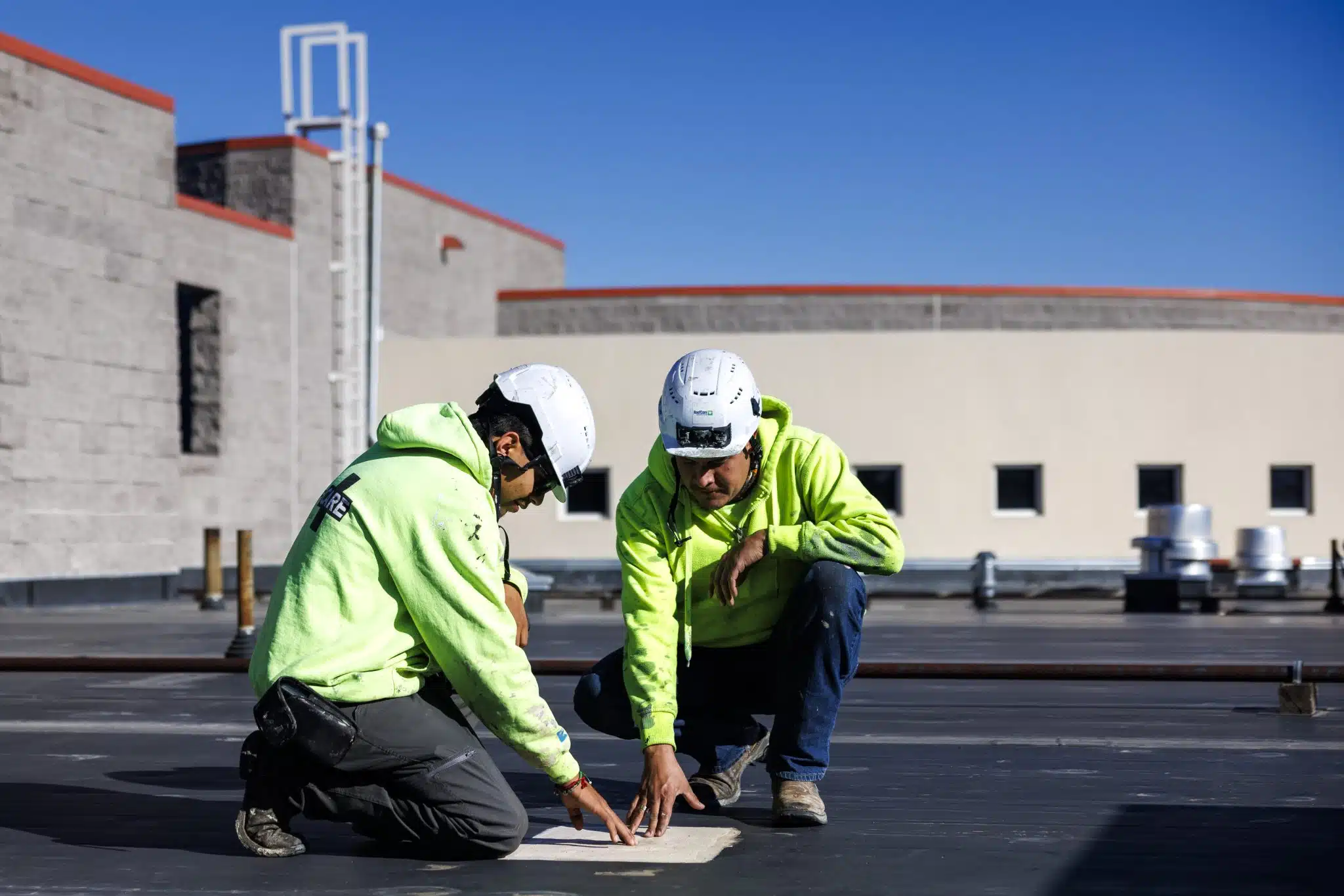
Site documentation: Full roof walk with photos keyed to a zone diagram. The zone diagram divides the roof into labeled sections - field areas, perimeter zones, equipment clusters, drain locations, parapet sections - and each photograph is logged to the zone where it was taken. The zone diagram is the navigational framework for the entire report and makes findings reproducible and verifiable on a future inspection.
Component condition ratings: Each major roof component is rated on a consistent scale - membrane field, membrane seams, penetration flashings, perimeter flashings, parapet and coping condition, drain and scupper condition, and rooftop equipment condition where relevant. The rating scale runs from serviceable through marginal to failed, with specific field observations supporting each rating. The scale is consistent across buildings and inspection cycles so findings are directly comparable.
Moisture assessment: Core pulls at representative locations - minimum 5 cores on roofs under 20,000 square feet, scaled upward for larger buildings. Each core documents insulation condition (dry, damp, or saturated) and includes a photograph of the core section. For larger buildings where surface scanning suggests concentrated wet zones - common on aging modified bitumen systems in the Cary and Morrisville office parks after multi-day rain events - infrared thermal scan is available as an add-on to the core pull protocol. The moisture assessment is the most consequential single data point for capital planning: wet insulation changes the scope from recover to replacement regardless of membrane surface condition.
Estimated remaining service life: Based on condition findings, we estimate remaining service life in years - expressed as a range rather than a point estimate, reflecting inherent uncertainty in projecting membrane degradation. The range is useful for capital planning and acquisition pricing. It is not a warranty.
Repair scope where applicable: Where conditions can be addressed with targeted repair - seam re-welding, drain bowl cleaning, flashing termination resealing, walkway pad replacement - we include repair scope descriptions with estimated square footage. Where conditions indicate that repair is inadequate and replacement or recover is the correct scope, we say so and explain why targeted repair does not produce a serviceable result.
Executive summary: One to two pages capturing the material findings, condition ratings, moisture assessment result, and estimated remaining service life - formatted for non-technical readers including lenders, investors, property managers, and insurance adjusters who need the finding without the technical detail.
Condition Reports for Specific Triangle Contexts
Acquisition due diligence: The Triangle's commercial transaction market - active in the North Hills and Midtown office submarkets, the Cary and Morrisville suburban office cluster, and the growing industrial and logistics corridors along I-40 and I-540 - generates sustained demand for third-party condition reports as part of buyer due diligence. A condition report for acquisition should document current system condition, estimated remaining service life, deferred maintenance obligations, and capital replacement cost range - so the buyer can price the roof asset into the acquisition. We produce reports structured for this purpose and have worked with buyers, their lenders, and their legal counsel on Triangle transactions including Triangle research corridor campus acquisitions, North Hills office tower refinancings, and mid-market suburban industrial deals.
Lender and CMBS documentation: Commercial lenders and CMBS servicers financing or refinancing Raleigh commercial buildings often require a current - within 12 months - roof condition report as part of the loan documentation package. Report format requirements for lender purposes sometimes specify particular content structure, component rating scales, and cost estimate formats. We produce reports to lender-specified formats when the format requirements are provided in advance of the inspection.
Insurance storm damage documentation: Hail events, tornado-track damage - including the March 2024 tornado that tracked through the North Raleigh and Wake Forest corridors - and hurricane-remnant moisture damage require documentation that separates pre-existing deterioration from event-caused damage. A condition report produced promptly after a damage event, with photo documentation keyed to the zone diagram, is the baseline the adjuster or the insured's representative works from. We do not represent insureds - we produce documentation the insured's representative can work with.
Manufacturer warranty compliance verification: Manufacturer warranties on Triangle commercial roofs typically require annual inspection and written documentation. A condition report produced to the manufacturer's required format serves as the annual maintenance record that keeps the warranty active. We produce compliance reports for buildings under active warranty from Carlisle, Johns Manville, Firestone, GAF, and other manufacturers with active commercial warranty programs in the Raleigh market.
Frequently asked questions
How long does a condition report inspection take on a typical Raleigh commercial building?
Half a day for buildings under 20,000 square feet. Full day for buildings from 20,000 to 75,000 square feet. Larger buildings or buildings with complex rooftop equipment inventories require 1.5 to 2 days. Core pulls add proportional time - a 15-core protocol on a large industrial building in the Garner or Clayton corridor is a full day of field work. Written reports are delivered within 5 to 7 business days of the inspection.
Can your condition report be used for insurance claims on storm damage in Raleigh?
Yes. Zone-diagram-keyed photo documentation and component condition ratings are the format insurance adjusters and public adjusters use to evaluate commercial claims. A condition report produced at the time of a damage event - before temporary repairs obscure the original damage - is far more useful than one produced after repairs have begun. For major storm events affecting multiple Triangle buildings, call 919-372-4890 directly to schedule priority post-storm inspection.
Can a condition report serve as the foundation for a competitive bid package?
Yes. The condition documentation - zone diagram, core pull data, component ratings, and repair scope descriptions - is the foundation of a defensible bid package. The condition report establishes existing conditions so contractors pricing against it are pricing the same scope rather than making independent assumptions about what they will find when the project starts.
Do you produce reports that meet ASTM E2018 standards?
Yes. ASTM E2018 is the standard guide for Property Condition Assessments used in commercial real estate transactions. Our condition reports for acquisition due diligence are produced to ASTM E2018 format requirements, including component condition ratings, deferred maintenance cost estimate ranges, and the executive summary structure. Buyers and lenders using ASTM E2018 PCA processes can specify this format when requesting the inspection.