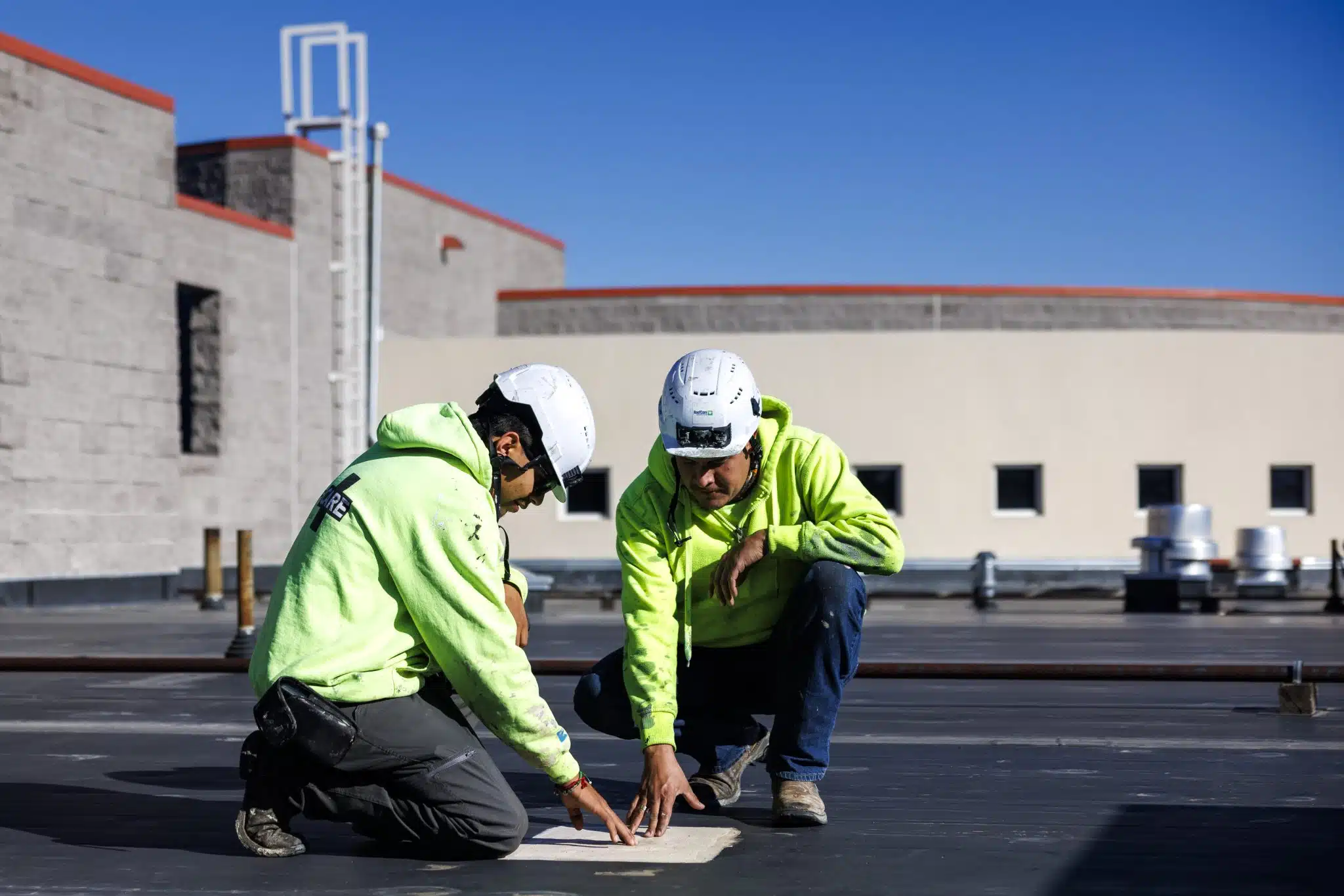
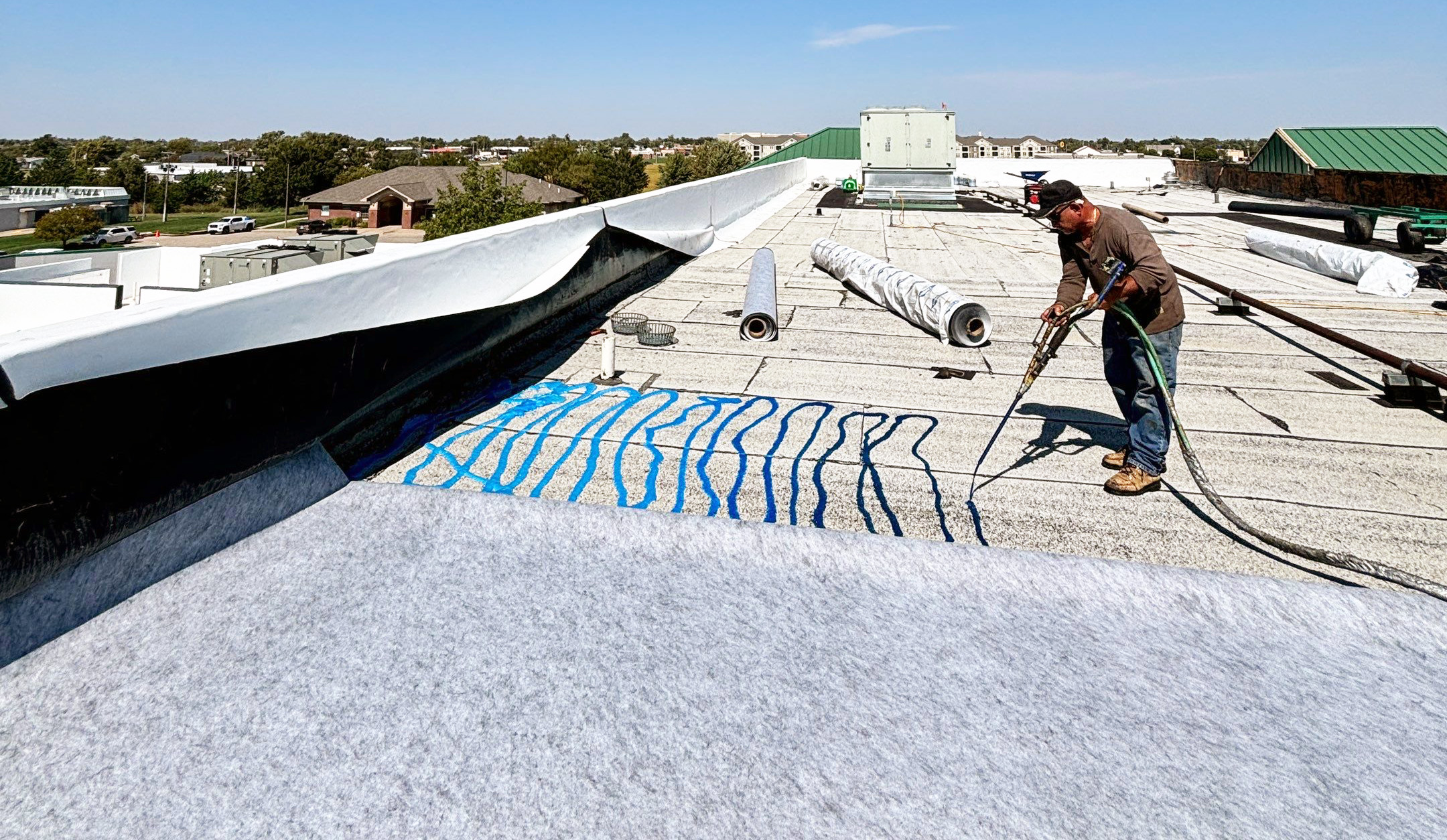
Installing a new membrane system over an existing Raleigh commercial roof - when insulation is dry, deck is sound, and the recover path produces a warranted system at roughly half the cost of full tear-off.
Roof recover is the right scope when the building conditions and economics support it: dry insulation confirmed by core pull, structurally sound deck, existing substrate compatible with the new system's adhesion or attachment requirements, and adequate parapet and curb height to accommodate the added assembly thickness. When all those conditions are met, recover delivers a new warranted membrane at roughly half the installed cost of full tear-off and replacement - without the debris management and disruption of removing a complete BUR or single-ply system from an occupied building.
The Triangle's building stock creates specific recover opportunities in the current cycle. The large inventory of 1990s modified bitumen systems in the North Hills, Cary, and Triangle research corridor office corridors - now at 25 to 30 years of age - frequently has dry insulation and sound substrate that supports a TPO recover. The older BUR inventory in the Warehouse District, the Capital Boulevard commercial corridor, and older industrial buildings along I-40 west includes buildings where smooth or coal-tar BUR surfaces are recoverable under single-ply when the moisture assessment passes. And the mid-life 45-mil TPO inventory from the 2003 to 2012 installation period - common in Morrisville, Durham, and Cary suburban office parks - is a strong silicone coating recover candidate where seam integrity is maintained.
We treat recover as a data-driven decision, not a default recommendation for buildings approaching the end of their original warranty life. The same core pull protocol we run for replacement scoping applies to recover evaluation - if cores come back wet, we do not proceed to recover. The same structural check applies - if the deck shows corrosion, deflection, or compromised fastener pull-out resistance, recover is off the table. And the parapet height check is non-negotiable: a recover that brings the new membrane surface within two inches of the parapet top eliminates the drip edge, traps water at the perimeter, and creates a water infiltration path that defeats the entire scope.
Recover Substrate Compatibility by System Type
Modified bitumen over BUR: The most common recover scenario in the Triangle's older commercial building stock. New SBS modified bitumen over a cleaned, gravel-free or gravel-embedded BUR surface. Gravel must be fully embedded in new bitumen, swept to bare substrate, or the recover system must be mechanically attached over a separator board above the gravel - attachment method depends on substrate condition and the new system's design. Modified bitumen recover over BUR produces a system suitable for another 15 to 20 years and carries manufacturer warranty terms in the 10 to 15-year range from most SBS manufacturers with Triangle market coverage.
TPO single-ply over existing single-ply: New 60-mil or 80-mil TPO mechanically attached or fully adhered over existing TPO, EPDM, or modified bitumen. The critical requirement is substrate compatibility - fully adhered TPO over existing EPDM requires EPDM-compatible bonding adhesive and specific surface preparation. Mechanically attached TPO over existing single-ply requires confirmation that the deck can receive the new fastener pattern without the existing fastener field creating interference. Manufacturer warranty availability for single-ply-over-single-ply recover is narrower than for new-to-deck applications - we verify warranty availability from the specified manufacturer before the recover scope is finalized.
Single-ply over BUR: TPO or EPDM mechanically attached over existing gravel-surface BUR, typically installed on a half-inch separator board laid over the gravel. This approach avoids gravel removal but adds height at roof curbs and parapets - the added assembly thickness must be checked against existing curb heights before the scope is confirmed. For buildings in the Downtown Raleigh commercial corridor where parapet heights are variable and often at minimum code clearance, this check is not optional.
Tapered Insulation in Triangle Recover Projects
Raleigh's drainage imperative: Raleigh's annual rainfall is delivered in high-intensity thunderstorm events that can produce 3 to 5 inches in an afternoon. Ponding on a recover system that has added membrane height without correcting existing low points will be worse than ponding on the original system - the added assembly thickness often creates new low points where parapet heights are marginal. Every recover scope we produce includes a tapered insulation assessment: documenting existing drain locations, mapping existing ponding areas, and specifying a tapered polyiso package that corrects ponding to positive slope at existing drains.
North Carolina energy code and slope requirement: The NC Energy Conservation Code - aligned with IECC 2021 - requires positive drainage slope on new and recover low-slope roofing installations. A recover project that adds membrane and insulation without correcting existing ponding zones does not meet code. Permit applications for Raleigh-area recover projects include the insulation design drawing; we document the tapered insulation package in the permit submission for all City of Raleigh, Town of Cary, and Wake County projects.
Net cost of tapered insulation in a recover: The added cost of tapered insulation in a recover project is partially offset by the elimination of tear-off labor and debris disposal. Net recover cost including tapered insulation correction and separator board where needed typically runs 50 to 65 percent of equivalent full replacement cost on Triangle commercial buildings with dry insulation and sound deck.
Recover Limitations and When Full Tear-Off Is Required
IBC two-layer limit on recover: The International Building Code as adopted in North Carolina limits low-slope roofing to two total membrane layers - the original installation and one recover. If a building already has a recover layer in place, the next scope is full tear-off regardless of insulation condition. We identify existing recover layers during the initial roof walk and document the layer count in the assessment report. Buildings in the older Triangle commercial inventory - particularly the pre-2000 warehouse stock along I-40 west and the older office buildings in the Five Points and downtown mixed-use corridor corridors - occasionally have an unrecorded recover layer that is not apparent until the inspection walk.
Parapet and curb height clearance: A recover assembly adds 1.5 to 3 inches of total height depending on the insulation thickness specified. If existing parapet height is less than 6 inches above the current membrane surface, a recover may bring the new membrane to within 2 to 4 inches of the parapet top - eliminating adequate counterflashing clearance and creating a water diversion problem at the perimeter. We measure parapet heights at representative locations during inspection and flag any recover-height conflict as a disqualifying condition.
Wet insulation in any field zone: Any zone of wet insulation found on core pull disqualifies the full recover scope and requires targeted insulation cut-out and replacement at wet areas before a recover can proceed - or full tear-off if saturation is widespread. We document core pull results by zone on the zone diagram so the owner can see exactly where the limitation exists and make an informed decision on scope without having to trust our interpretation alone.
Frequently asked questions
How do you determine if recover is right for my Raleigh building versus full replacement?
Core pull data and layer count control the decision. Dry insulation and a single existing roof layer: recover is a candidate. Wet insulation or an existing recover layer: tear-off is required. We produce a written assessment with core pull data so the decision is based on documented conditions, not a contractor recommendation unsupported by field data.
Can I get a manufacturer warranty on a recover installation in Raleigh?
Yes, in most cases. Most major manufacturers - Carlisle, Johns Manville, Firestone, GAF - offer 15 to 20-year NDL warranty programs for single-ply recover installations on qualifying substrates. Warranty availability depends on the recover system type, substrate condition, and the manufacturer's approval of the assembly design. We verify warranty availability before the recover specification is finalized and include the manufacturer approval path in the pre-construction plan.
Does a recover project require a building permit in Raleigh?
Yes. The City of Raleigh, Town of Cary, City of Durham, and Wake County all require building permits for low-slope recover work exceeding the repair threshold - generally any recover covering more than 25 percent of the roof area. We pull permits as part of standard pre-construction on all recover projects and coordinate the required inspection from the relevant municipal building inspections division.
How much faster is a recover project than full tear-off on an occupied Raleigh commercial building?
Recover eliminates the tear-off and debris-removal phase, which typically accounts for 25 to 40 percent of the production schedule on a full replacement. A 30,000-square-foot recover project in the North Hills or Midtown corridor runs 7 to 10 business days of production versus 12 to 15 for an equivalent full replacement. For occupied buildings with tenant-notification and parking-management constraints - common in the Downtown Raleigh and Cary corporate corridors - the shorter production window has real value independent of the cost difference.