Property Type
Roof assessment, replacement, and maintenance for Raleigh churches - from the historic sanctuaries along Edenton Street and Hillsborough Street to the growing megachurch campuses on the outer Raleigh corridors - scoped around congregation schedules and the specific roof geometry of worship facilities.
Religious building roofing in Raleigh spans two very different building types. The historic downtown churches - First Baptist Church on Salisbury Street, Hayes Barton Baptist on Glenwood Avenue, Christ Church Episcopal on Capital Square, and the cluster of historic African American congregations along South Blount Street - are buildings with architectural character that the congregation regards as sacred. Roof work on these buildings is expected to preserve that character, and the building committees that govern these decisions are thoughtful stewards of the structures in their care.
The growing megachurch campuses on the outer Raleigh corridors - Summit Church's main campus in Triangle research corridor and their Brier Creek and North Raleigh campuses, Crossroads Fellowship on Walnut Street, and the continuing expansion of large multi-site congregations across Wake County - represent the opposite end of the spectrum: purpose-built commercial construction with large-span roof systems, multiple buildings, and operational complexity comparable to a corporate campus.
Both building types require the same respect for the congregation's schedule. A Sunday morning service is not a day you can have tear-off debris on the ground outside the sanctuary entrance, no matter how tight the production timeline is. Religious building roofing runs around the congregation's calendar, and every scope conversation we have with a facilities committee starts with that calendar.
Historic Downtown Raleigh Churches
Raleigh's historic church buildings along Edenton Street, Salisbury Street, and the Capitol Square corridor represent some of the oldest continuously occupied buildings in Wake County. First Presbyterian Church on Salisbury Street has been on its current site with documented experience. Christ Church Episcopal on Capitol Square dates to Methodist Church has a steeple that has defined the Downtown skyline for generations.
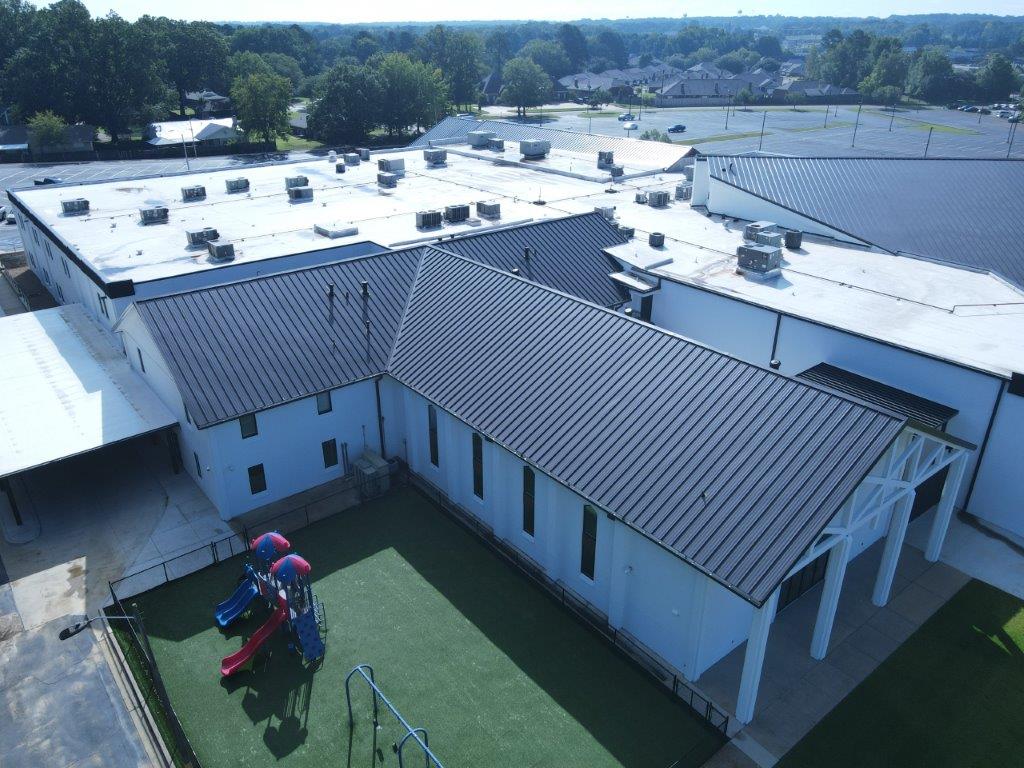
Roofing these buildings means working on structures with multiple roof systems - the main sanctuary roof (often slate, clay tile, or standing seam metal on the original historic structures), flat membrane sections on education wings and fellowship halls added in the twentieth century, and the complex interface conditions where addition rooflines connect to the original structure. We assess each roof system separately because each has its own condition profile and its own appropriate repair or replacement approach.
Historic preservation requirements apply to some of these buildings - either through local landmark status, National Register listing, or State Historic Preservation Office review requirements for buildings receiving state or federal funds. If your church building has a preservation designation or is considering one, the roof work scope needs to be developed in coordination with a preservation architect and, potentially, reviewed by the SHPO. We are familiar with that process and can work within it.
Megachurch Campus and Multi-Site Buildings
The Summit Church's Triangle research corridor campus - their main gathering site in Durham, with satellite campuses in North Raleigh, Brier Creek, and South Durham - is the scale anchor of the megachurch segment in the Triangle. A production building designed for multiple services per weekend, with full production infrastructure, HVAC systems designed for 2,000-seat capacities, and cafe and childcare wings with their own mechanical requirements, is a different roof project than a historic downtown sanctuary.
Multi-site megachurch campuses present the same portfolio opportunity as multi-building commercial real estate. A consolidated condition assessment across all campus locations gives the church's facilities team a documented view of their total roofing asset, with a capital-planning horizon that they can use in budget planning for the next three to five years. We have done this kind of portfolio assessment for secular clients managing multiple commercial buildings and the approach translates directly to a multi-campus church organization.
Crossroads Fellowship's Walnut Street campus, North Raleigh Community Church, and the wave of congregation-owned commercial buildings in the Brier Creek, Knightdale, and Garner corridors make up a significant share of the religious building inventory in Wake County. Many of these buildings were constructed in the 2000s growth wave and are approaching the end of their original 20-year TPO or EPDM systems.
Working Around Congregation Schedules
Most religious buildings operate on a schedule that is predictable but constraining. Sunday mornings are off-limits for any work that creates visible or audible disruption at the sanctuary entrance. Wednesday evenings and Thursday mornings often carry programming that affects access. Holiday periods - Advent and Christmas, Holy Week and Easter, High Holy Days for synagogues and Jewish institutions - are periods when the building is in peak use and production must stop entirely or be limited to non-impacting interior-facing work.
We build the congregation calendar into the production schedule before mobilization. The facilities committee or facilities director provides a calendar of programming and high-use periods, and we plan the production sequence around that calendar - not as an afterthought, but as the first constraint in the schedule logic. If a holiday period falls during the production window, we plan the sequence so that the building is under dry-in cover and visually secure before the congregation arrives for the holiday.
Facilities committees for historic downtown churches are often composed of volunteers with deep institutional knowledge of the building and strong ownership of the outcome. We present production plans to those committees directly, explain the sequencing logic, and answer questions with the same specificity we would bring to a conversation with a facilities manager at a commercial building. The building committee is the client.
Frequently asked questions
Can you work on a historic church roof that has a preservation designation?
Yes, with appropriate coordination. Historic preservation designations - local landmark status, National Register listing, or SHPO review requirements - shape the scope of what can be done to the historic roof fabric. On a slate or clay tile roof with preservation status, the repair or replacement scope will typically require matching original materials, or a documented determination that equivalent materials are appropriate. We can work with the church's architect or a preservation consultant to develop a scope that meets the preservation requirements and produces a roof system that will perform. We do not begin work on a designated historic building without confirming the scope against the applicable preservation standards.
Our church has multiple buildings with different roof systems. Where do you start?
We start with an assessment that documents the condition and remaining service life of every roof section on every building. That assessment gives the facilities committee a prioritized list - buildings with active leaks or less than three years of estimated remaining service life first, buildings with sound conditions and multiple years of remaining life identified for future capital planning. The facilities committee can then make an informed decision about sequencing based on the church's capital budget, not on the roofing contractor's production preferences.
What flat roof system do you recommend for a modern church sanctuary building?
For a purpose-built modern sanctuary building with a large-span flat or low-slope roof, 60-mil TPO with a 20-year NDL manufacturer warranty is the standard recommendation for most Raleigh area religious buildings. It handles the Triangle's climate well, its reflective surface reduces cooling loads for a building with high occupancy during services, and its maintenance requirements are straightforward. For buildings with significant rooftop mechanical equipment or complex geometry, we assess on-site before recommending a system - the right membrane depends on the specific building conditions.